
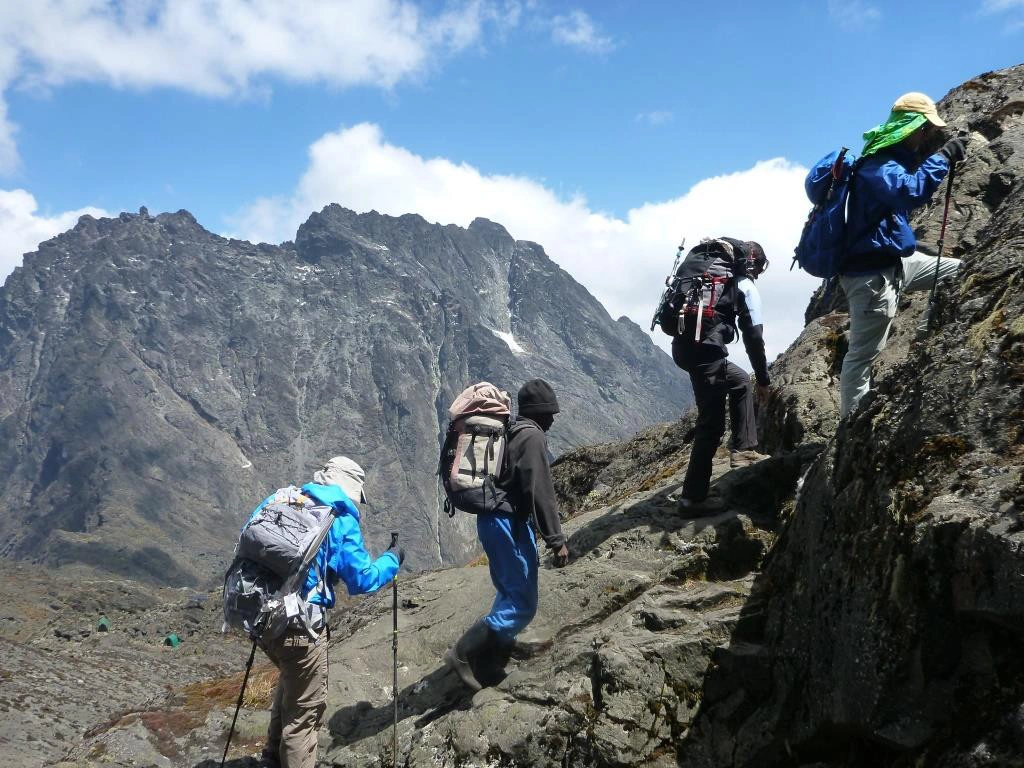
Rwenzori Mountains National Park. Long before the age of maps and satellite imagery, ancient geographers wrote of a great range of snow-capped mountains deep in the heart of Africa that gave rise to the Nile. They called them the Mountains of the Moon. What they described — and what explorers eventually confirmed in the nineteenth century — were the Rwenzori Mountains, a vast, ancient, and permanently cloud-wrapped range straddling the border of Uganda and the Democratic Republic of Congo in the western Rift Valley. Rwenzori Mountains National Park protects the Ugandan portion of this extraordinary range, and it stands today as one of the most remarkable natural destinations on the entire African continent — a UNESCO World Heritage Site, a Ramsar Wetland of international significance, and a mountain range unlike any other on earth.
Rising to 5,109 metres at Margherita Peak on Mount Stanley — the third-highest point in Africa — the Rwenzoris are not simply a destination for serious mountaineers. They are a living ecological marvel of five distinct vegetation zones, glacial lakes, giant groundsels, endemic birds found nowhere else on earth, and Bakonzo cultural traditions woven deeply into the fabric of the mountain itself. At Self Drive Safaris Uganda, we help adventurous travellers reach this spectacular park in western Uganda with confidence, with 4×4 vehicles and expert route guidance that ensures the journey to one of Africa’s greatest wilderness destinations is as rewarding as the destination itself.
About Rwenzori Mountains National Park
Rwenzori Mountains National Park is located in the extreme southwestern corner of Uganda, straddling the border with the Democratic Republic of Congo in the districts of Kasese, Kabarole, and Bundibugyo — approximately 400 kilometres from Kampala, a six to seven hour drive via Mbarara to the gateway town of Kasese. The park covers an area of approximately 996 square kilometres and was gazetted as a national park in 1991. In 1994 it was inscribed as a UNESCO World Heritage Site in recognition of its outstanding natural beauty and exceptional biodiversity, and in 2008 it was additionally designated a Ramsar Wetland of International Importance.
The Rwenzori Mountains themselves are not volcanic in origin — unlike most of East Africa’s great peaks — but are a block mountain range formed by ancient geological uplift, giving them a fundamentally different character from Kilimanjaro or Mount Elgon. The range extends approximately 120 kilometres in length and 65 kilometres in width, and is composed of six major massifs: Mount Stanley (5,109m), Mount Speke (4,890m), Mount Baker (4,843m), Mount Emin (4,798m), Mount Gessi (4,715m), and Mount Luigi di Savoia (4,627m). The highest point — Margherita Peak on Mount Stanley — is the third-highest permanently snow-capped summit on the African continent, and the only point in Uganda with permanent glaciers.
The park is managed by the Uganda Wildlife Authority, which works in close partnership with the Rwenzori Mountaineering Services and the Rwenzori Trekking Services to manage the main trekking routes, maintain mountain huts, and coordinate ranger escorts for all hikers. The UWA has recently completed significant safety improvements to the approach to Margherita Peak, including a bridge across a crevasse in the Margherita glacier, confirming the resumption of summit trekking to the highest point in Uganda.
The Extraordinary Vegetation Zones of the Rwenzoris
What makes Rwenzori Mountains National Park truly singular among African mountain destinations is not simply its altitude or its glaciers — it is the extraordinary sequence of vegetation zones that hikers pass through on the ascent, each more surreal and otherworldly than the last. Nowhere else in Africa can a single trek take you from dense tropical montane forest through bamboo groves, across giant heather moorland, into a landscape of prehistoric giant lobelias and groundsels, and finally onto glacial ice — all within the space of a few days.
The lowest zone, between the park boundary and approximately 2,500 metres, is dense montane forest — a rich, dark, dripping world of podocarpus, bamboo, and tree ferns where primates call from the canopy and endemic birds move through the undergrowth. Above 2,500 metres, bamboo gives way to a zone of giant Rapanea trees and enormous heathers, draped in lichens, mosses, and epiphytes that glow in extraordinary colours after rain. This zone has a quality of enchantment that few forests on earth can match — ancient, silent, heavily atmospheric.
Above 3,000 metres, the mountain opens into moorland of extraordinary botanical richness. Here grow the giant lobelias and giant groundsels — the emblematic plants of East Africa’s highest mountains — which reach heights of several metres and give the Rwenzori landscape its signature prehistoric, almost alien quality. These plants are slow-growing and ancient, and walking among them on the upper moorland is one of the most visually astonishing experiences in all of African trekking. Above 4,000 metres, the vegetation thins to open alpine heath before the rock and glacial ice of the summit zone begins.
This layered, living botanical spectacle is the true wildlife experience of Rwenzori Mountains National Park, and it is why the park is sometimes described as offering the greatest concentration of unique and endemic plant life of any protected area in Africa.
Wildlife at Rwenzori Mountains National Park
Rwenzori Mountains National Park is home to over 70 mammal species, with the richest wildlife concentrated in the lower montane forest zones below 2,500 metres. Forest elephants move quietly through the dense undergrowth of the lower slopes, leaving their distinctive rounded footprints in the soft forest floor. Leopards — including the rare and elusive Rwenzori leopard, a distinctive high-altitude subspecies — inhabit the montane forest and heath zones, and chimpanzees live in the lower forest areas, occasionally encountered on guided nature walks from the park base.
Black-and-white colobus monkeys are among the most spectacular primates of the Rwenzori forest, swinging through the high canopy in flowing white-mantled troops that are a constant and beautiful presence on any lower-slope walk. L’Hoest’s monkeys, blue monkeys, and hyrax are all regularly encountered, and the three-horned chameleon — one of the most sought-after reptiles in all of Uganda — is found throughout the montane forest zone. Giant forest hogs, duikers, and bushbucks complete the mammalian cast of the lower forest.
Higher on the mountain, above the tree line, the wildlife gives way to the extraordinary botanical life of the moorland and alpine zones. In these upper reaches, the Rwenzoris are — as one celebrated wildlife guide put it — a park where the main wildlife is the vegetation itself, and where the botanical big game of giant lobelias and ancient groundsels provides a wildlife encounter of a completely different and equally profound kind.
Birdwatching at Rwenzori Mountains National Park
Rwenzori Mountains National Park is one of the finest birdwatching destinations in all of East Africa, sheltering 217 confirmed bird species — including 19 Albertine Rift endemic species found only in the mountain ranges of the western rift valley. The Rwenzori forest is one of the most important habitats for these highly localised birds, and dedicated birdwatchers come from around the world to seek out species that cannot be found anywhere else.
Among the most prized endemic and near-endemic species are the Rwenzori turaco — a stunning bird with crimson wings that flashes brilliantly through the forest canopy — the Rwenzori batis, the Rwenzori double-collared sunbird, the Rwenzori nightjar, Archer’s robin-chat, the red-throated alethe, the strange weaver, and the handsome francolin. The lower montane forest near Nyakalengeija — the main trailhead — and the forest around Lake Mahoma at 2,651 metres are particularly productive birding areas, combining endemic forest species with montane specialists in a compact and accessible setting.
For birdwatchers who do not wish to undertake a multi-day summit trek, the lower forest trails and the Mahoma Nature Trail offer exceptionally rewarding half-day and full-day birding walks that can yield many of the park’s headline endemic species without requiring the physical commitment of a summit attempt.
Trekking Routes to Margherita Peak
The ascent of Margherita Peak — Uganda’s highest point and the third-highest summit in Africa — is one of the great trekking achievements available to anyone visiting East Africa. At 5,109 metres, the peak sits above the permanent snowline and requires hikers to cross glacial ice on the final approach, making it a genuine mountaineering objective that demands respect, preparation, and the right equipment. Yet it is also accessible to fit, determined, and properly guided hikers who do not necessarily have technical climbing experience — a combination that places it in a special category among Africa’s great summit experiences.
The Central Circuit Trail is the most famous and most widely used route to Margherita Peak, beginning from the trailhead community of Nyakalengeija in Kasese District and ascending through the Mubuku River valley to the slopes of Mount Baker before the final approach to Mount Stanley and the summit. The route passes through all five vegetation zones and takes seven to nine days for a full circuit, with nights spent in well-maintained mountain huts including Nyabitaba (2,651m), John Matte (3,505m), Elena Hut (4,541m), and the Kitandara Lakes camps. The trail traverses the legendary Bujuku Valley, crosses the Scott Elliot Pass, and visits the stunning Kitandara Lakes — twin glacial pools at 4,023 metres that are among the most beautiful high-altitude lakes in Africa.
The Kilembe Trail is the second major route, beginning from the mining town of Kilembe south of Kasese and ascending through the southern slopes of the range. This longer route — managed by the Rwenzori Trekking Services — is considered the most scenic and comprehensive option, allowing maximum acclimatisation time and passing through the full range of the mountain’s landscapes, glacial lakes, and vegetation zones. It typically takes nine to twelve days and receives outstanding reviews for the quality of its mountain huts and guide infrastructure.
For hikers who want a taste of the Rwenzoris without committing to a summit trek, the Mahoma Nature Trail offers a rewarding two to three day circular route reaching Lake Mahoma at 2,651 metres — a beautiful glacial lake surrounded by moss-draped forest that is one of the most accessible and enchanting destinations in the park. Day walks from the park gate through the lower forest zones are also available and offer exceptional wildlife and birdwatching experiences.
The Bakonzo People: Culture at the Foot of the Mountains of the Moon
The Bakonzo people have lived on the slopes of the Rwenzori Mountains for centuries, and their culture, traditions, and spiritual life are inseparable from the mountains that tower above their villages. The Bakonzo are the indigenous inhabitants of the Rwenzori foothills, and the community of Ruboni — located at the base of the Central Circuit Trail near Kasese — is the primary cultural gateway to their world for visitors to the park.
A cultural visit to Ruboni offers one of the most authentic and moving community experiences in western Uganda. Traditional dances, music performances, storytelling sessions, and guided village walks introduce visitors to Bakonzo customs, agricultural practices, and the deep spiritual significance of the mountains. The Bakonzo believe the Rwenzoris are the home of Kithasamba — the supreme spirit of the mountains — and their relationship with the peaks is one of reverence, respect, and profound cultural continuity.
At Bulemba on the lower slopes, visitors can also see the remains associated with Isaiah Mukirania Kibanzaga, the first King of the Rwenzururu Kingdom, who played a central role in preserving Bakonzo identity and dignity through a period of significant political upheaval. These cultural encounters add a rich and deeply human dimension to what is already one of Uganda’s most spectacular natural experiences, and visiting Ruboni before or after a Rwenzori trek is strongly recommended for all travellers.
Best Time to Visit Rwenzori Mountains National Park
The Rwenzori Mountains are famous for being among the wettest mountain ranges in Africa — they straddle the equator and receive rainfall from two wet seasons, creating conditions that are permanently moist, atmospheric, and frequently cloudy. This characteristic wetness is part of what makes the Rwenzoris so dramatically beautiful, but it also means that timing a visit carefully can significantly improve trekking conditions.
The best months for trekking and summit attempts are the two dry seasons: June to August and December to February. During these windows, the trails are drier, the sky is more frequently clear, and the views from the upper mountain — including the spectacular panoramas of the glaciated peaks and the Albertine Rift Valley far below — are most likely to reward hikers with clear visibility. Even during the dry seasons, rainfall can occur at any time on the Rwenzoris, and warm, waterproof, and layered clothing is absolutely essential for any visit to the mountain.
For birdwatching on the lower forest trails, the park offers rewarding experiences throughout the year. The montane forest is active with birds and wildlife in all seasons, and the lush quality of the forest during the wet season adds a particular beauty to birding walks in the lower zones. Our team at Self Drive Safaris Uganda can advise on the best timing and preparation for any Rwenzori Mountains trekking or safari itinerary.
How to Get to Rwenzori Mountains National Park
Rwenzori Mountains National Park is accessed via the town of Kasese in western Uganda, approximately 400 kilometres from Kampala — a journey of six to seven hours by road via Mbarara, passing through the rolling hills of Ankole country and the dramatic Rwenzori foothills as Kasese comes into view. The main trailhead for the Central Circuit, Nyakalengeija, is located approximately 22 kilometres from Kasese town.
The drive from Kampala to Kasese is entirely on tarmac and is comfortable in a 4×4 vehicle, which is the recommended option for travel in the region. Many travellers combine the Rwenzori Mountains with visits to Queen Elizabeth National Park — located just one to two hours from Kasese — or Kibale Forest National Park for chimpanzee trekking, creating a richly varied western Uganda safari circuit. Our Uganda self-drive safari routes include detailed guidance for combining the Rwenzoris with Uganda’s other western park destinations.
For those preferring to fly, Aerolink Uganda operates domestic flights from Entebbe to Kasese Airstrip, reducing travel time to approximately one hour. All trekking on the mountain requires a permit from the Uganda Wildlife Authority, and all hikes are conducted with mandatory ranger escorts for safety throughout.
Where to Stay at Rwenzori Mountains National Park
The town of Kasese serves as the main accommodation base for visitors to Rwenzori Mountains National Park, and the nearby Ruboni community area at the foot of the Central Circuit trailhead has developed excellent options for those wanting to be as close to the mountain as possible. The Rwenzori Turaco View Campsite in Mihunga village is a charming community-owned property offering thatched accommodation and camping with views of the mountain range. The Ruboni Community Camp offers comfortable base camp accommodation with cultural activities and guided nature walks in the immediate mountain environment.
For those on the mountain itself, the trekking huts along the Central Circuit and Kilembe trails provide basic but comfortable overnight facilities at each camping stage, with bunk beds, cooking facilities, and essential equipment maintained by the trail management services. In Kasese town, Sandton Hotel and Margherita Hotel offer comfortable mid-range accommodation with easy access to the park headquarters and trekking outfitters. The luxury option closest to the park is the Ihamba Lakeside Safari Lodge near Lake George, which combines Rwenzori mountain views with access to Queen Elizabeth National Park activities.
Why Rwenzori Mountains National Park Is Africa’s Most Extraordinary Trekking Destination
The Rwenzori Mountains are in a category entirely their own. They are older than memory, wrapped in cloud and mystery, botanically unlike anywhere else on earth, and home to a summit experience that combines the physical challenge of high-altitude mountaineering with a botanical and cultural journey of extraordinary richness and beauty. Standing at Margherita Peak — on the roof of Uganda, on the third-highest point in Africa, looking out over a world of glaciers, crater lakes, and the great sweep of the western Rift Valley — is an experience that places you in the company of the great African adventurers who came before.
The Uganda Tourism Board and UNESCO both recognize Rwenzori Mountains National Park as one of Uganda’s and Africa’s most significant natural heritage sites, and the park’s twin designations as a World Heritage Site and a Ramsar Wetland reflect the global importance of its ecological and hydrological role across the entire region.
Explore our full range of Uganda safari packages and self-drive itineraries to begin planning your journey to the Mountains of the Moon — and discover for yourself why the ancient geographers who first wrote of these peaks chose, above all others, to call them legendary.
Related posts

Leave a Comment