
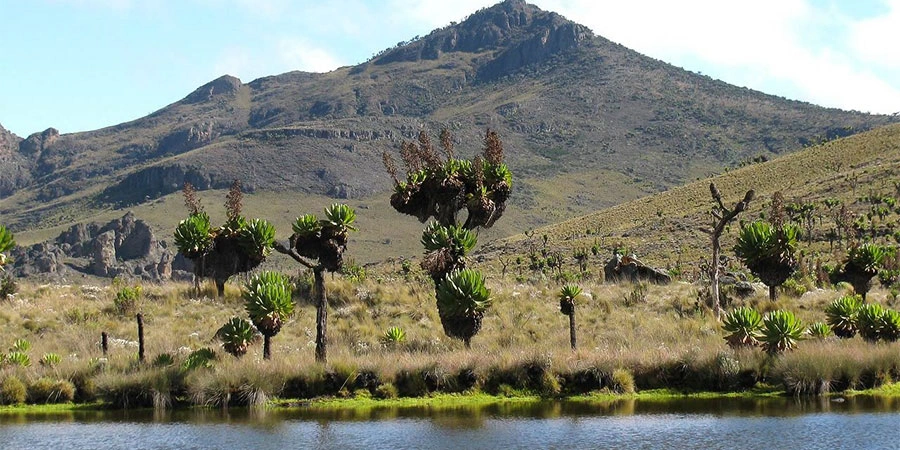
Mount Elgon National Park. On the eastern border of Uganda, where the land rises dramatically from the flat plains of the east into a world of ancient forest, bamboo, moorland, and alpine heath, stands one of Africa’s most extraordinary and least-visited natural wonders. Mount Elgon is an extinct volcano estimated to be 24 million years old, and it holds the distinction of having the largest volcanic base of any mountain on earth — broader at its base than Kilimanjaro itself. Mount Elgon National Park, which protects the Ugandan slopes of this ancient giant, is a UNESCO-recognised Man and Biosphere Reserve and one of Uganda’s most rewarding destinations for hikers, birdwatchers, and travellers seeking a safari experience that is completely unlike anything else in the country.
From the thundering cascades of Sipi Falls to the mysterious elephant caves carved into the volcanic rock, from the sweeping caldera at the summit to the rich Bagisu and Sabiny cultures of the surrounding communities, Mount Elgon National Park offers a depth of experience that surprises every visitor who arrives expecting a simple mountain hike. At Self Drive Safaris Uganda, we help travellers reach this spectacular corner of eastern Uganda with confidence, providing the right 4×4 vehicles and route guidance for a journey to one of the country’s most underappreciated national parks.
About Mount Elgon National Park
Mount Elgon National Park is located on the eastern border of Uganda in the districts of Mbale, Sironko, Bulambuli, and Kapchorwa, approximately 235 kilometres from Kampala — a journey of around four to five hours by road via Tororo. The Ugandan portion of the park covers 1,110 square kilometres, forming the larger part of a transboundary protected area shared with Kenya, where an additional 169 square kilometres of the mountain fall under the jurisdiction of the Kenya Wildlife Service. The park is jointly managed on the Ugandan side by the Uganda Wildlife Authority, which has protected these slopes since the park was officially gazetted in 1992.
The protection of Mount Elgon actually began much earlier — the area was designated a Forest Reserve in 1929, declared Mount Elgon Crown Forest in 1940, and elevated to a Central Forest Reserve in 1951 before finally being gazetted as a national park. This long history of protection has preserved a landscape of remarkable ecological integrity, and UNESCO has recognised it as a Man and Biosphere Site in acknowledgement of its outstanding botanical diversity and ecological value.
The centrepiece of the park is Mount Elgon itself — an extinct volcano whose highest point, Wagagai Peak, rises to 4,321 metres above sea level and lies entirely within Uganda. The mountain’s caldera, one of the largest intact calderas in the world at approximately eight kilometres in diameter, contains hot springs, crater lakes, and views of breathtaking scale that reward every hiker who reaches the top. The lower slopes of the mountain descend through a succession of distinct vegetation zones — dense montane forest giving way to bamboo, then to Afro-alpine moorland and finally to the open heathland and giant lobelias of the upper mountain — creating a journey through some of Africa’s most extraordinary highland ecosystems.
Wildlife at Mount Elgon National Park
Mount Elgon National Park is home to a fascinating and diverse array of wildlife, much of it concentrated in the rich montane forest and bamboo zones of the lower and middle mountain slopes. The park shelters approximately 40 mammal species, including African forest elephants, buffaloes, Defassa waterbucks, bushbucks, oribis, giant forest hogs, spotted hyenas, and several primate species. Black-and-white colobus monkeys are a common and spectacular sight in the montane forest, swinging through the high canopy with their flowing white mantles. Blue monkeys and red-tailed monkeys are also regularly encountered along the forest trails, and olive baboons are frequently seen on the forest margins.
The African forest elephant is perhaps the most remarkable and unexpected wildlife presence on Mount Elgon. These elephants are famous throughout the world for their extraordinary nocturnal behaviour — entering the caves carved into the mountain’s volcanic rock to mine salt from the walls with their tusks. This behaviour, developed over thousands of years, has created cave systems of astonishing size and depth, and the evidence of their nightly excavations — tusk gouges in the cave walls, enormous footprints in the soft floor — is visible to every visitor who explores these extraordinary spaces.
The wildlife of Mount Elgon is best encountered on guided walks and hikes through the lower forest zones, where the density of primates, antelopes, and birdlife is highest. Unlike the game-drive parks of the savannah, wildlife viewing here is a walking experience, which makes encounters feel intimate, unhurried, and genuinely wild.
Birdwatching at Mount Elgon National Park
Mount Elgon National Park is one of Uganda’s most important birding destinations, sheltering approximately 300 bird species — including 40 species whose entire Ugandan range is restricted to the slopes of Mount Elgon alone. This high level of endemism places it in a special category among Uganda’s birding destinations, and dedicated birders from around the world travel specifically to tick species that simply cannot be found anywhere else in the country.
Among the most prized endemics and near-endemics are the Jackson’s francolin, the black-collared apalis, the moustached green tinkerbird, the Hunter’s cisticola, and the Elgon francolin — all of which are essentially exclusive to this mountain’s forest and heath zones. The Rwenzori turaco, African hill babbler, and several species of sunbird, warbler, and flycatcher add to an exceptional species list that rewards both experienced and casual birders.
The Piswa Trail is widely regarded as the best route for birdwatching on Mount Elgon, passing through towering podocarpus forest — a pristine Afro-montane woodland that supports the greatest density of endemic bird species. The forest exploration centre at Kapkwai, close to the Sipi Falls area, is an excellent starting point for dedicated birding walks that can be done as half-day or full-day excursions without committing to a multi-day summit trek.
Sipi Falls: The Jewel of Mount Elgon
No visit to Mount Elgon National Park is complete without spending time at Sipi Falls — a series of three spectacular waterfalls that cascade down the volcanic escarpment of the mountain’s southwestern slopes, surrounded by lush vegetation, terraced farmland, and sweeping panoramic views across the plains of eastern Uganda far below. Sipi Falls is one of Uganda’s most photographed and celebrated natural landmarks, and the area around the falls has developed into a charming base for travellers visiting Mount Elgon.
The largest of the three falls plunges over 100 metres into a pool below, and guided hikes to the base, middle, and top of the falls offer completely different perspectives of this remarkable landscape. The hike to the top of the main falls passes through community farmland and reveals extraordinary views across the Karamoja plains on a clear day, stretching far into the northeastern horizon.
For those seeking an adrenaline experience, abseiling down the face of the main Sipi Falls is one of the most thrilling activities in all of eastern Uganda — descending beside the roaring curtain of white water with the valley floor spread below is a genuinely unforgettable moment. Coffee tours in the surrounding Arabica coffee-growing communities add a warm cultural and agricultural dimension to any Sipi Falls visit, and the area’s lodges — perched on the cliff edge with views directly over the falls — are among the most beautifully situated accommodations in the country.
The Elephant Caves of Mount Elgon
One of the most extraordinary and unique natural phenomena in all of Uganda — and indeed, in all of Africa — can be found deep within the volcanic rock of Mount Elgon. The mountain’s caves, carved from ancient lava deposits over millions of years, have been dramatically enlarged over the centuries by forest elephants who enter them nightly to mine salt from the mineral-rich cave walls using their tusks and trunks.
The most famous of these is Kitum Cave, located on the Kenyan side of the mountain, but the Ugandan slopes contain their own remarkable cave systems, including Tutum Cave along the Sipi Trail and Chepnyalil Cave, both of which show the extraordinary scale of the elephants’ excavation work. The gouges left by tusks in the cave walls, the enormous footprints preserved in the soft floor, and the sheer darkness and scale of these underground chambers create an atmosphere of prehistoric wonder that is unlike any other experience in Uganda.
Guided cave visits are arranged through the Uganda Wildlife Authority and the park’s forest exploration centres, and combining a cave visit with birdwatching on the Piswa or Sipi trails makes for an exceptionally rich half-day or full-day experience that requires no summit trekking at all.
Hiking Trails to Wagagai Peak
The summit experience at Mount Elgon is the park’s greatest adventure, and the mountain offers an exceptional hiking destination for one compelling reason that its more famous East African counterparts cannot match — it is genuinely accessible. The slopes are less steep and the altitude gain more gradual than on Kilimanjaro or the Rwenzori Mountains, meaning that fit but non-specialist hikers can reach Wagagai Peak with good preparation and the right equipment. The summit sits at 4,321 metres, well above the altitude threshold where altitude sickness becomes a consideration, so proper acclimatisation and a measured pace are important.
The Sasa Trail is the shortest and most direct route to the summit, beginning from the town of Budadiri in the Sironko Valley and ascending steeply through the park’s largest bamboo forest to the peaks. The round trip takes three to four days and is recommended for strong, experienced hikers who are comfortable with a steep and challenging ascent. The trail passes through dense bamboo before opening into Afro-alpine moorland and the dramatic approach to the caldera rim.
The Piswa Trail is the most scenic and wildlife-rich route, beginning from the forest exploration centre at Kapkwai near Sipi Falls and winding gradually upward through towering podocarpus forest, heath, and moorland to the peaks. This trail takes approximately five to six days and is ideal for birders, photographers, and hikers who want to experience the full range of the mountain’s vegetation zones at a comfortable pace. The trail also passes hot springs within the caldera, making it the most complete summit experience on the mountain.
The Sipi Trail offers a middle option — a route of four to six days that combines elements of both the Sasa and Piswa approaches while passing through the dramatic Sipi Falls landscape on the ascent. All trekking routes have designated camping stages with water sources, tent pads, and basic latrines, and all hikes are conducted with Uganda Wildlife Authority ranger escorts for safety and wildlife guidance throughout.
The Bagisu and Sabiny: Cultural Experiences Around Mount Elgon
Mount Elgon National Park sits at the heart of the territories of two of Uganda’s most culturally distinctive communities — the Bagisu people, who inhabit the western and southern slopes, and the Sabiny people, who live on the higher eastern escarpment. Both communities have deep spiritual and cultural connections to the mountain, and visiting them adds a powerful human dimension to any Mount Elgon safari.
The Bagisu revere the mountain as the physical manifestation of Masaba, their founding father, and call it by his name. Their most celebrated cultural tradition is the Imbalu — a circumcision ceremony that marks the passage of young men into adulthood and is held every even-numbered year with music, dance, body painting, and community celebration of extraordinary vibrancy. Visitors who time their trip to coincide with the Imbalu season experience one of the most extraordinary cultural events in East Africa.
Coffee tours with Bagisu farming communities on the slopes around Sipi Falls have become increasingly popular, offering visitors the chance to follow the full Arabica coffee production process from cherry to cup — harvesting, washing, drying, roasting, and brewing — in the shadow of one of Africa’s most ancient volcanoes. These experiences directly support local livelihoods and create meaningful connections between travellers and the communities that have shaped this landscape for generations.
Best Time to Visit Mount Elgon National Park
Mount Elgon National Park can be visited and hiked throughout the year, but the two dry seasons offer the most comfortable conditions for summit treks and waterfall hikes. The primary dry season runs from June to August, and the shorter dry season covers December to February. During these months, the trails are drier, the skies are more frequently clear, and the views from the summit and along the escarpment are at their most spectacular.
The wet seasons — March to May and September to November — bring heavy rainfall to the mountain, which can make trails muddy and slippery, particularly on the steeper sections of the Sasa Trail. However, the forest is at its lushest during the wet season, waterfalls are at their most powerful and dramatic, and the birdwatching is particularly rewarding as species are active and vocal throughout the day. Sipi Falls is a year-round destination, though the falls are most impressive during and immediately after the rains.
Regardless of season, warm and waterproof clothing is essential for any visit to the upper mountain, as temperatures drop significantly at altitude and rainfall can occur at any time of year. Our team at Self Drive Safaris Uganda can advise on the best timing and preparation for a Mount Elgon safari combined with other eastern or northern Uganda destinations.
How to Get to Mount Elgon National Park
Mount Elgon National Park is located approximately 235 kilometres from Kampala, with the road journey taking four to five hours via the town of Tororo to Mbale, which serves as the main gateway to the park. Mbale is a well-equipped regional city with good hotels, restaurants, and services, and the Mount Elgon National Park headquarters is located here. From Mbale, the two principal trailheads are accessible — Budadiri to the northeast for the Sasa Trail, and Kapkwai near Sipi Falls to the east for the Piswa and Sipi trails.
The Sipi Falls area in Kapchorwa District is accessible from Mbale in approximately one and a half hours on a scenic road that climbs up the mountain escarpment through terraced farmland and coffee gardens. A 4×4 vehicle is recommended for this approach, and is essential for travel during the wet season. Our self-drive 4×4 car hire Uganda options include vehicles specifically suited to eastern Uganda’s mountain roads, giving independent travellers the freedom to explore at their own pace and on their own schedule.
Mount Elgon can also be combined with visits to the Sipi Falls area, the Semuliki National Park, or the broader eastern Uganda circuit including Jinja and the source of the Nile, creating an excellent and varied multi-day itinerary across the east of the country. Explore our Uganda self-drive safari routes for inspiration on building the perfect eastern Uganda journey.
Where to Stay at Mount Elgon National Park
The Sipi Falls area offers the most developed and atmospheric accommodation in the Mount Elgon region. Sipi River Lodge is the flagship property, a beautifully positioned lodge perched on the cliff edge with direct views over the falls and the valley below. The lodge’s Waterfall Cottages — Aniet, Kapsurur, Chepkui, and Toben — each have private verandas overlooking the falls, and the Riverside Bandas blend local architectural traditions with comfortable amenities. The property serves as an excellent base for both Sipi Falls activities and the Piswa and Sipi trail treks.
For hikers tackling the Sasa Trail from Budadiri, Roses Last Chance is a popular and well-located budget option. In Mbale town, Mount Elgon Hotel — housed in a renovated colonial building — provides comfortable mid-range accommodation with easy access to the park headquarters and trekking outfitters. The Uganda Wildlife Authority manages basic camping facilities within the park itself, with camping stages along all major trekking routes equipped with water sources, tent pads, and latrines.
Why Mount Elgon National Park Deserves Its Place on Your Uganda Safari
Mount Elgon National Park is the great undiscovered jewel of Uganda’s national park network. While the crowds head west to the gorilla parks or north to Murchison Falls, the eastern slopes of this ancient volcano offer a safari experience of extraordinary richness and variety — world-class hiking through five distinct vegetation zones, endemic birdwatching found nowhere else in Uganda, elephant caves carved by tusks over thousands of years, the magnificent triple cascade of Sipi Falls, and the living cultural traditions of the Bagisu and Sabiny people.
It is a park that rewards the curious, the active, and the adventurous in equal measure. And because it sits on one of Uganda’s main eastern highways, it can be incorporated into almost any Uganda safari itinerary as a powerful and memorable addition. The Uganda Tourism Board continues to promote Mount Elgon as one of Uganda’s most exciting emerging destinations — and travellers who make the journey consistently describe it as one of the most surprising and fulfilling experiences of their entire African adventure.
Start planning your Mount Elgon safari today with our full range of Uganda self-drive safari packages and 4×4 car hire options and let us help you reach this extraordinary corner of Uganda in style and comfort.
Related posts


Leave a Comment