
Lake Mburo National Park. Not every great safari requires a two-day journey into remote wilderness. Some of the most rewarding wildlife encounters in Uganda happen just four hours from Kampala, along a gently rolling landscape of acacia woodland, shimmering lakes, and open savannah where zebras graze and leopards prowl through the long grass after dark. Lake Mburo National Park is Uganda’s smallest savannah national park and its most accessible — a compact, richly diverse gem that offers an extraordinary range of activities including boat cruises, horseback riding safaris, night game drives, and guided walking safaris in a park where the absence of lions and elephants makes it uniquely safe to explore on foot.
For travellers heading south or west from Kampala — to Bwindi Impenetrable Forest, Queen Elizabeth National Park, or the gorilla parks — Lake Mburo makes an ideal and deeply rewarding stopover. And for those who simply want to experience Uganda’s wildlife without a long drive, it is the perfect destination in its own right. At Self Drive Safaris Uganda, Lake Mburo is one of our most recommended parks for independent travellers, offering excellent roads, a compact footprint, and an atmosphere of relaxed, unhurried discovery.
About Lake Mburo National Park
Lake Mburo National Park is located in the Kiruhura District of western Uganda, in Nyabushozi County, approximately 245 kilometres from Kampala — a comfortable four-hour drive along the tarmac highway that connects the capital to the western region. The park covers an area of approximately 370 square kilometres and sits at an altitude of between 1,220 and 1,828 metres above sea level, nestled in the rain shadow between the Rwenzori Mountains and Lake Victoria.
The park’s history is as turbulent as it is fascinating. The area was first designated a controlled hunting area in 1933, then upgraded to a game reserve in 1963. In 1983 it was gazetted as a national park — controversially displacing the Banyankole pastoralists who had long occupied the land. When the political landscape shifted, those communities returned and significantly reduced wildlife populations through poaching. Through sustained conservation efforts by the Uganda Wildlife Authority, the park has been carefully restored, and wildlife numbers have recovered remarkably. Today, Lake Mburo National Park stands as a conservation success story and one of Uganda’s most beloved safari destinations.
The park is centred around its magnificent namesake lake, Lake Mburo, and encompasses 13 lakes in total — five of which lie within the park boundaries. These lakes are connected by a vast wetland system fed by the River Rwizi, creating a mosaic of aquatic, grassland, and woodland habitats that supports extraordinary biodiversity across a relatively small area. Twenty percent of the park’s total surface is permanent wetland, providing habitat for an array of wildlife rarely found elsewhere in Uganda.
Wildlife at Lake Mburo National Park
Lake Mburo National Park is distinctive among Uganda’s national parks in the particular character of its wildlife. It is the only park in Uganda where visitors can see impalas, elands, and klipspringers — three antelope species absent from every other Ugandan park. It also holds Uganda’s largest concentration of zebras, with approximately 5,000 Burchell’s zebras roaming the open grasslands alongside topis, waterbucks, oribis, reedbucks, warthogs, buffaloes, bushbucks, and giant forest hogs.
The park is home to approximately 68 mammal species and is particularly celebrated among wildlife enthusiasts for its exceptional leopard population. Lake Mburo National Park is widely regarded as the best place in Uganda to spot leopards, which occur at an unusually high density within the park’s woodland and rocky habitat. A spot known to rangers and visitors as “Leopard Rock” is one of the most productive locations in Uganda for leopard sightings, especially during night game drives and at first light.
In recent years, Rothschild’s giraffes have been reintroduced to the park, having been translocated from Murchison Falls National Park. These elegant animals are now a regular and exciting presence in the acacia woodlands, and watching a giraffe browse against the backdrop of Lake Mburo at sunset is one of the park’s most iconic sights.
The absence of lions and elephants in Lake Mburo National Park is not a shortcoming — it is what makes it uniquely special. It is the only savannah national park in Uganda where visitors are permitted to walk freely in the presence of wildlife, opening up safari experiences that simply do not exist elsewhere in the country. The fringing swamps around the lakes harbour the secretive sitatunga antelope and the papyrus gonolek, while hippo pods are permanent residents of the lakeshore. Nile crocodiles bask on sandbanks, and river otters are occasionally spotted slipping quietly between the reeds.
Birdwatching at Lake Mburo National Park
Lake Mburo National Park is one of Uganda’s finest and most underrated birding destinations, with over 350 bird species recorded across its diverse habitats. The combination of savannah, acacia woodland, papyrus swamp, open water, and riverine forest creates ecological conditions that support an exceptional range of both resident and migratory species.
The lake itself and its surrounding wetlands attract impressive concentrations of waterbirds. African fish eagles perch imperiously over the water, their haunting calls echoing across the lake at dawn. Malachite kingfishers dart like living jewels along the reedy banks. African jacanas walk across lily pads with improbable grace, and African finfoots — one of Uganda’s most sought-after and elusive waterbirds — are reliably seen along the quieter inlets and channels.
The papyrus swamps are particularly productive for specialist species. The papyrus gonolek — a brilliantly coloured, swamp-dwelling bird found only in papyrus — is a prized sighting, along with the blue-headed weaver, the white-winged warbler, and the secretive sitatunga, which is as much a birding habitat indicator as it is a wildlife highlight. The Rubanga Forest within the park shelters over 40 bird species of its own, including the grey-backed camaroptera, the double-toothed barbet, the harrier hawk, and African green pigeon. The rare shoebill stork — one of the most sought-after birds on the African continent — is occasionally spotted in the swampy margins, most reliably during the dry season when water levels drop.
For dedicated birders, a combination of a boat cruise on the lake, a guided walk through Rubanga Forest, and a dawn game drive through the acacia woodland can yield well over 100 species in a single day — a remarkable achievement for a park of this size.
The Boat Cruise on Lake Mburo
One of the most peaceful and memorable activities in Lake Mburo National Park is the boat cruise on Lake Mburo itself — a two-hour journey departing from the Rwonyo Jetty that takes visitors along the eastern shores of the lake in close proximity to some of the park’s most spectacular wildlife. The cruise typically launches at 8:00 am, when the morning mist is still lifting from the water and the birdsong is at its most intense.
From the boat, visitors drift past enormous pods of hippos — often in the hundreds — surfacing and submerging with territorial grunts that reverberate across the water. Nile crocodiles lie motionless on sandbanks just metres away, and buffaloes wade into the shallows to drink. Zebras and impalas gather at the lake’s edge in the early morning, and giraffes occasionally stride down to the water in the golden light of sunrise. Otters are sometimes spotted fishing in the quieter coves, and the birdwatching throughout the cruise is consistently excellent.
The boat cruise is one of the most rewarding wildlife experiences in the entire country — intimate, unhurried, and full of surprise encounters — and represents extraordinary value for the time invested. It is best done during the dry season when animals concentrate around water sources, though the lake is accessible for cruising year-round.
Unique Activities at Lake Mburo National Park
What sets Lake Mburo apart from every other national park in Uganda is not just its wildlife or its landscape — it is the sheer variety of ways in which visitors can experience it. No other park in Uganda offers this combination of land, water, and adventure activities in a single compact destination.
Horseback riding safaris are one of Lake Mburo’s most beloved and distinctive experiences, operated from the stables at Mihingo Lodge. Riders are led through the savannah and acacia woodland on horseback, and because wildlife in the park has become accustomed to horses, animals react very differently to mounted visitors than they do to vehicles — approaching much closer and allowing for intimate encounters that are genuinely thrilling. Zebras, impalas, topis, and warthogs have all been photographed from horseback at remarkably close range. The rides typically last four hours and are suitable for adults and children alike, with experienced guides leading every session.
Night game drives are another highlight unique to Lake Mburo among Uganda’s smaller parks. Conducted in a safari vehicle with a powerful spotlight and an armed Uganda Wildlife Authority ranger, the two-hour nocturnal drive transforms the familiar savannah into a world of completely different encounters. Leopards emerge from their daytime hiding places to patrol their territories. Bush babies peer from the branches with enormous reflective eyes. Genet cats, white-tailed mongooses, bush pigs, hyenas, and porcupines become visible in the sweeping beam of the spotlight, and the whole experience carries an edge of excitement that daytime game drives cannot replicate.
Guided walking safaris in Lake Mburo are a deeply satisfying way to experience the park’s wildlife and vegetation at a completely different pace. Because there are no lions or elephants in the park, walks can proceed through open grassland and along the lakeshore with a level of safety and freedom impossible in Uganda’s other major parks. Salt lick viewpoints, where zebras, antelopes, and other animals come to lick mineral-rich earth, are particularly productive spots to visit on foot in the early morning.
Sport fishing is permitted on Lake Mburo and several of the other lakes within the park, with tilapia being the most commonly caught species among the six fish species present in the lake. Fishing permits are issued by the Uganda Wildlife Authority, and the Mazinga area is the designated fishing zone. Cycling and community cultural visits to the Igongo Cultural Centre — which houses an outstanding museum dedicated to the tribes of southwestern Uganda — round out a remarkably diverse portfolio of activities for a park of this size.
Best Time to Visit Lake Mburo National Park
Lake Mburo National Park is open to visitors every day of the year, including weekends and public holidays, and offers rewarding experiences across all seasons. The dry seasons — June to September and December to February — are considered the best time to visit for wildlife viewing, as animals concentrate around the permanent lakes and water sources, vegetation is lower giving better visibility, and road and trail conditions are at their easiest.
The wet seasons, from March to May and October to November, bring their own character to the park — the acacia woodland turns a vivid green, migratory bird species arrive in large numbers, and the park carries a beautiful lushness that is very different from its dry season appearance. Birding is particularly rewarding during the wet season, as a wider range of species is present and waterbird activity on the lake is at its most intense.
Lake Mburo’s location along the main Kampala-to-Mbarara highway and its compact size make it an ideal and flexible destination for travellers at any time of year. Whether you are making a dedicated two-night stay or using it as a stopover on the way to Bwindi or Queen Elizabeth, the park rewards every visit. Our team at Self Drive Safaris Uganda can help you incorporate Lake Mburo into any southwest Uganda safari itinerary.
How to Get to Lake Mburo National Park
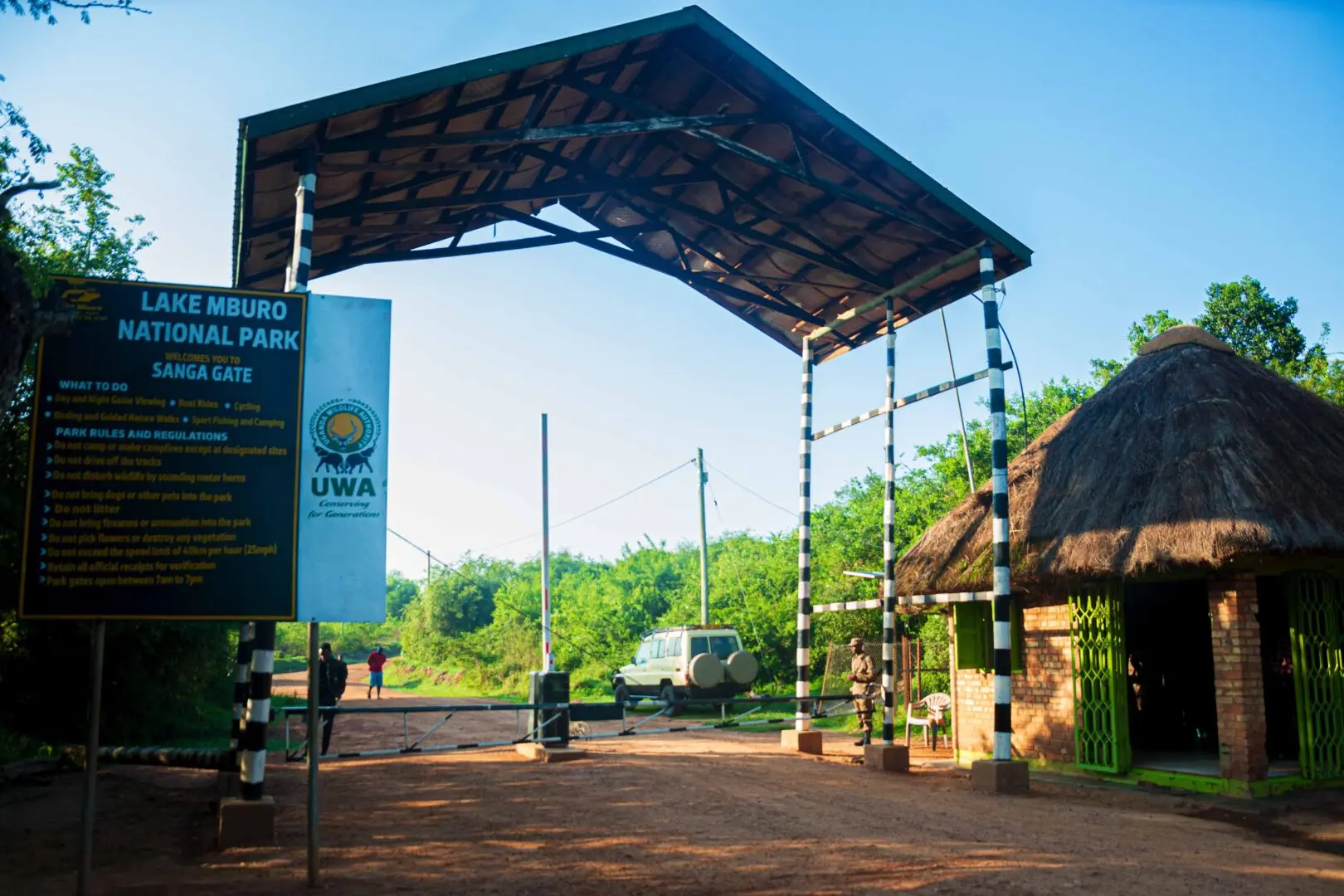
Lake Mburo National Park is one of the easiest parks in Uganda to reach independently. The park lies approximately 245 kilometres from Kampala along the well-paved Kampala-Mbarara highway — a four-hour drive that is entirely comfortable in a standard saloon vehicle, though a 4×4 is recommended for travel within the park, particularly during the wet season. The main entrance gate, Sanga Gate, is just 13 kilometres off the main highway, and the signage from the highway turnoff is clear and straightforward.
The park’s strategic location along the Kampala-to-Mbarara route makes it the natural stopping point for travellers journeying west to Bwindi Impenetrable Forest, Mgahinga Gorilla National Park, Queen Elizabeth National Park, or Kibale Forest National Park. A night or two at Lake Mburo breaks the journey beautifully and adds a completely different wildlife dimension to any broader Uganda safari circuit. Explore our Uganda self-drive safari itineraries to find the perfect route combining Lake Mburo with Uganda’s other great parks.
Where to Stay at Lake Mburo National Park
Lake Mburo National Park offers an excellent range of accommodation options for every budget and travel style. Mihingo Lodge is the park’s flagship luxury property, a beautifully designed hilltop lodge with stunning views over the savannah and direct access to the horseback riding programme. Rwakobo Rock Lodge and Kigambira Safari Lodge offer comfortable mid-range options set within the park’s wildlife-rich landscape.
For budget-conscious travellers, Rwonyo Rest Camp — managed by the Uganda Wildlife Authority and located directly on the lakeshore — provides simple, well-positioned accommodation with easy access to the boat cruise jetty. Arcadia Lodge, Lake Mburo Safari Lodge, Mantana Tented Camp, and Leopard Rest Camp round out a wide selection that ensures every type of traveller can find the right base for their Lake Mburo experience.
Why Lake Mburo National Park Belongs on Your Uganda Safari
Lake Mburo National Park proves, definitively, that the most memorable safari experiences do not always come from the most remote or the largest parks. In just a few days, this compact and accessible park delivers wildlife encounters that are genuinely unique — the only impalas, elands, and klipspringers in Uganda; among the best leopard sightings in the country; a boat cruise on a lake ringed with hippos and birds; a horseback safari through open savannah; and a night drive that brings the forest alive in an entirely new way.
Its position on the main road west makes it the perfect companion to Uganda’s other great destinations, and its proximity to Kampala makes it the ideal first or final stop on any Uganda safari. The Uganda Tourism Board consistently highlights Lake Mburo as an underappreciated jewel of Uganda’s national park network — and every traveller who spends a night on its shores quickly understands why.
Start planning your Lake Mburo adventure today with our full range of Uganda self-drive safari packages and 4×4 car hire options and discover the park that surprises every visitor who arrives expecting something small and leaves having found something truly extraordinary.
Related posts

Leave a Comment