
Mgahinga Gorilla National Park Uganda. Where three ancient volcanoes rise from the mist along the borders of Uganda, Rwanda, and the Democratic Republic of Congo, a small but extraordinary national park sits quietly at the edge of the Albertine Rift. Mgahinga Gorilla National Park is Uganda’s smallest national park, covering just 33.7 square kilometres, yet within that compact landscape lies one of the most rewarding and diverse safari experiences in all of East Africa. Here, mountain gorillas roam the high-altitude forest, golden monkeys blaze through bamboo thickets in flashes of russet and gold, volcanic summits reward hikers with views across three countries, and the ancient Batwa Pygmies — the original forest people — share their extraordinary culture with visitors on guided trails through the trees.
Mgahinga may be overlooked by travellers who head straight to Bwindi Impenetrable Forest, but those who make the journey to this volcanic corner of Uganda discover a park of rare and intimate beauty. At Self Drive Safaris Uganda, we help adventurous travellers navigate the roads to Mgahinga with confidence, with fully equipped 4×4 vehicles and detailed route guidance for Uganda’s spectacular southwest.
About Mgahinga Gorilla National Park
Mgahinga Gorilla National Park is located in the Kisoro District of southwestern Uganda, tucked into the farthest corner of the country where Uganda meets Rwanda and the DRC. The park sits at an altitude of between 2,227 metres and 4,127 metres above sea level — making it one of the highest national parks in Uganda — and forms a critical part of the wider Virunga Conservation Area, a transboundary protected ecosystem shared between Uganda, Rwanda, and the Democratic Republic of Congo.
The area was first declared a game sanctuary by the British colonial administration in 1930 and was gazetted as a national park in 1991, primarily to protect the endangered mountain gorillas that inhabit its forests. The park takes its name from the local Kinyarwanda word “gahinga,” meaning the piles of volcanic stones cleared from farmland at the foot of the volcanoes — a reminder of how deeply the landscape has been shaped by both natural forces and human history over thousands of years.
The park is managed by the Uganda Wildlife Authority and forms part of the same volcanic mountain chain as Rwanda’s Volcanoes National Park and the DRC’s Virunga National Park, meaning that wildlife — including gorillas — occasionally moves across these shared borders. This transboundary nature makes Mgahinga a unique destination: a single park woven into a much larger, internationally significant conservation landscape.
Mountain Gorilla Trekking at Mgahinga
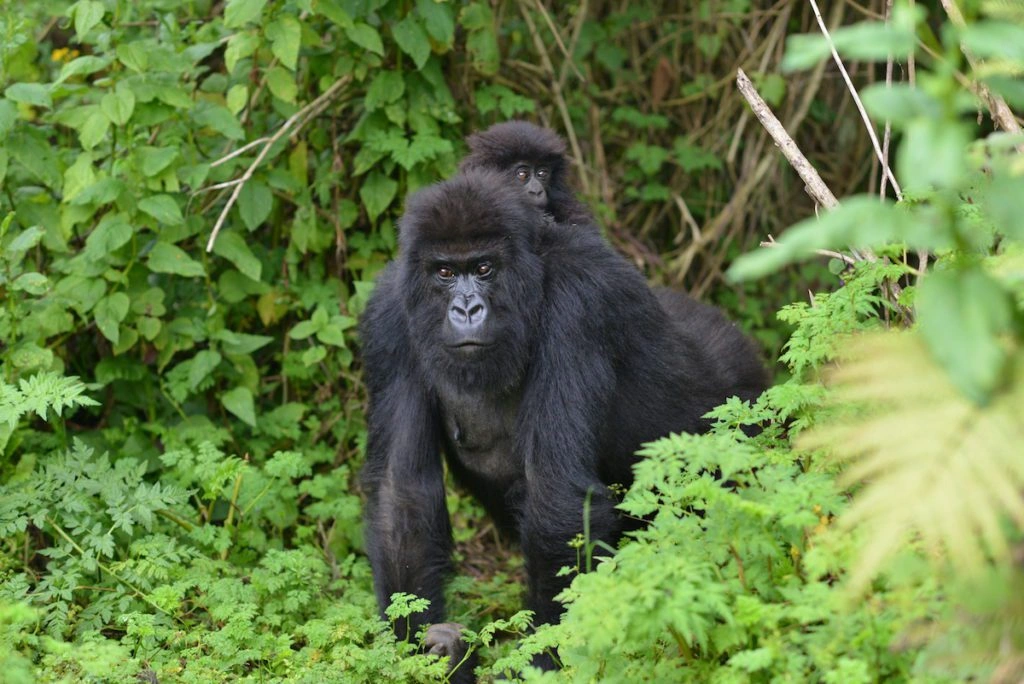
The mountain gorilla is the star of Mgahinga Gorilla National Park, and coming face to face with these magnificent great apes in their high-altitude volcanic habitat is an experience of extraordinary power and emotion. The park is home to one habituated gorilla group — the Nyakagyezi family — which is available for daily trekking from the Ntebeko Gate. Gorilla trekking in Mgahinga begins with a briefing at 8:00 am, after which visitors are led by experienced park rangers into the forest in search of the group.
The Nyakagyezi group is one of the largest habituated mountain gorilla groups in the entire Virunga region, and because it has largely settled within Uganda’s territory in recent years, locating the family tends to be more straightforward than some treks in Bwindi Impenetrable Forest. The trek can take anywhere from thirty minutes to several hours depending on the gorillas’ daily movements, and visitors are permitted to spend one hour with the family once they have been found.
One distinctive characteristic of the Mgahinga gorillas is their exceptionally thick, fuzzy coats — a natural adaptation to the high altitude and cooler temperatures of the Virunga volcanic environment. Watching these gentle giants — silverbacks, mothers, and playful youngsters — move through the misty highland forest against a backdrop of ancient volcanoes is a moment that stays with visitors for a lifetime.
The gorilla trekking permit for Mgahinga costs USD 800 per person, issued by the Uganda Wildlife Authority, and should be booked well in advance through the UWA website or a registered tour operator, particularly during peak season. Because there is only one habituated family available for trekking in Mgahinga, permit availability is more limited here than at Bwindi, where multiple families trek daily. For travellers planning a combined gorilla and broader Uganda safari, explore our Uganda self-drive safari routes to build the perfect itinerary.
Golden Monkey Tracking: Mgahinga’s Hidden Treasure
One of the most enchanting and often underappreciated experiences in Mgahinga Gorilla National Park is tracking the golden monkey — a beautiful, energetic, and vividly coloured primate found only in the Virunga Mountains of the Albertine Rift. Uganda is one of only two countries in the world where golden monkeys can be tracked in their natural habitat, with Mgahinga being the premier destination in Uganda for this extraordinary encounter.
The golden monkey is an instantly recognisable animal, with a bright russet-gold back and flanks that contrast sharply with its black limbs and face. These sociable primates live in large groups and are most commonly found in the park’s lush bamboo zones — the same mid-altitude forest that mountain gorillas also traverse. Tracking sessions take visitors into the bamboo thickets where the monkeys feed, play, and leap between stems with breathtaking agility. Unlike gorilla trekking, golden monkey tracking has a permit cost significantly lower than USD 800, making it an excellent addition to any Mgahinga visit or an accessible alternative for travellers who have not secured a gorilla permit.
The golden monkey tracking experience in Mgahinga offers an intimate and joyful wildlife encounter — the monkeys are often encountered in numbers, and their playful, acrobatic behaviour makes for spectacular photography. Combining gorilla trekking one morning with golden monkey tracking the next is one of the most satisfying ways to experience the full richness of Mgahinga in a single extended visit.
The Three Virunga Volcanoes: Hiking Above the Clouds
Mgahinga Gorilla National Park is the only park in Uganda where visitors can hike active and dormant volcanoes, and the three peaks within the park — Mount Gahinga, Mount Sabinyo, and Mount Muhavura — each offer a different hiking challenge and a completely different reward at the summit.
Mount Gahinga, at 3,474 metres, is the most accessible of the three volcanoes and is suitable for hikers of varying fitness levels. The trail winds through a beautiful succession of vegetation zones — open farmland gives way to dense bamboo forest, which yields to Afro-montane heath and finally the open summit, where a swamp-filled crater fringed with giant lobelias awaits. The round trip takes approximately five to seven hours and rewards hikers with panoramic views across the Virunga landscape. Golden monkeys are frequently encountered in the bamboo zones along the trail.
Mount Sabinyo, at 3,669 metres, is the most technically interesting climb, featuring steep ridges and dramatic scenery en route to a summit that sits precisely at the meeting point of three countries — Uganda, Rwanda, and the DRC. Standing on the summit of Sabinyo, you are simultaneously in three nations, a geographic achievement that few travellers ever experience. The round trip takes approximately eight hours and passes through Afro-montane forest rich in birdlife and wildlife.
Mount Muhavura is the tallest and most demanding of the three volcanoes, rising to 4,127 metres above sea level. The ascent is strenuous and takes eight to ten hours round trip, but the reward is extraordinary — a stunning crater lake at the summit and sweeping panoramic views of the entire Virunga chain, Lake Mutanda, and the distant hills of Rwanda and Congo. Only physically fit and well-prepared hikers should attempt Muhavura, but those who reach the top will find the experience unforgettable. All volcano hikes in Mgahinga are conducted with park ranger escorts, and permits are required for each summit.
The Batwa Cultural Trail: Encounter with the Forest People
Among the most moving and profound experiences available in Mgahinga Gorilla National Park is the Batwa Cultural Trail — a guided journey with members of the Batwa Pygmy community, the indigenous hunter-gatherers who lived within these forests for thousands of years before the park was established in 1991.
The Batwa were the original custodians of the Virunga forest, living entirely within its canopy as hunters, gatherers, and healers who understood the forest’s rhythms, medicines, and seasons in ways that no outsider could replicate. When conservation necessitated their resettlement outside the park boundaries, the Batwa lost not only their homes but also much of their traditional way of life. Today, the Batwa Cultural Trail invites visitors to walk with Batwa guides through the forest, learning directly from them about their ancient methods of hunting, their knowledge of medicinal plants, their fire-making techniques, their music, their stories, and their spiritual connection to the forest that shaped their identity for generations.
The trail is both deeply educational and genuinely moving — a reminder that conservation and human rights are inseparable, and that the communities who have lived alongside wildlife for millennia are essential partners in protecting it. Participating in the Batwa Cultural Trail directly supports Batwa community livelihoods and cultural preservation. It is an experience that adds extraordinary human depth to any Mgahinga safari, and one that visitors consistently describe as one of the most memorable moments of their entire Uganda journey.
Wildlife and Birdwatching at Mgahinga
Beyond its famous primates, Mgahinga Gorilla National Park supports a diverse and compelling array of wildlife. The park is home to approximately 39 mammal species, including forest elephants, buffaloes, leopards, bushbucks, duikers, giant forest hogs, and side-striped jackals — all inhabiting the forest and bamboo zones that cover the lower slopes of the volcanoes.
For birdwatchers, Mgahinga offers a rewarding experience within a compact area. Over 180 bird species have been recorded in the park, including 14 Albertine Rift endemics — species found only in the mountains of the western Rift Valley and nowhere else on earth. Prized sightings include the Rwenzori turaco, the dusky crimsonwing, the handsome francolin, the paradise flycatcher, and the stunning African firefinch. Dedicated birding walks can be arranged with park rangers, and the bamboo forest zones at mid-altitude are particularly productive for endemics and forest specialists.
The Albertine Rift location of Mgahinga places it within one of Africa’s most important biodiversity hotspots, and every walk in the park — whether following gorillas, golden monkeys, or simply exploring the trails — is accompanied by the continuous backdrop of birdsong from the canopy above.
Best Time to Visit Mgahinga Gorilla National Park
Mgahinga Gorilla National Park can be visited and enjoyed at any time of year, and gorilla trekking operates on a daily basis regardless of season. However, the dry seasons — June to September and December to February — are widely regarded as the best time to visit. During these months, the mountain trails are drier and less slippery, the roads leading into Kisoro and the park are in better condition, and the morning mist often clears to reveal the spectacular volcanic landscape at its most photogenic.
The wet seasons, from March to May and October to November, bring the lush green intensity of the high-altitude forest at its most vibrant. The park is quieter during these months, permit availability is generally easier, and accommodation rates tend to be lower. However, the steep volcanic trails can become muddy and challenging in heavy rain, and a good pair of waterproof hiking boots is essential at any time of year given the park’s high-altitude environment.
For travellers combining Mgahinga with Bwindi Impenetrable Forest — just a few hours apart by road — or with a visit to Queen Elizabeth National Park or Lake Bunyonyi, the dry season offers the most comfortable overall conditions. Our team at Self Drive Safaris Uganda can help you plan the ideal route and timing for a southwest Uganda safari circuit.
How to Get to Mgahinga Gorilla National Park
Mgahinga Gorilla National Park is located approximately 540 kilometres from Kampala, with the road journey taking around nine to ten hours via Mbarara and Kabale to the town of Kisoro, which serves as the main gateway to the park. The route through Uganda’s southwest is one of the most scenic drives in the country, passing through the terraced hills of Kigezi, the dramatic crater lake region around Kabale, and finally the volcanic skyline of the Virunga Mountains as Kisoro comes into view.
From Kisoro town, the park’s Ntebeko Gate is approximately 14 kilometers, and the final road into the park passes through farmland and community areas at the foot of the volcanoes. A 4×4 vehicle is essential for the approach roads, particularly during the wet season. Our self-drive 4×4 car hire Uganda service provides vehicles that are specifically equipped for the southwestern Uganda roads, giving independent travellers the freedom and reliability they need for this remote but deeply rewarding destination.
For those preferring to fly, Aerolink Uganda operates charter and scheduled flights from Entebbe to Kisoro Airstrip, reducing the journey to under two hours. Mgahinga also sits within easy reach of Rwanda — Kigali is approximately four to five hours away via the Cyanika border crossing, making a combined Uganda-Rwanda gorilla safari entirely practical and increasingly popular among international travellers.
Where to Stay at Mgahinga Gorilla National Park
Accommodation options near Mgahinga are more limited than at Bwindi, which is part of what gives the park its intimate and exclusive atmosphere. The flagship lodge is Mount Gahinga Lodge, a beautifully designed property situated in the shadow of the Virunga volcanoes at the park entrance, offering luxury tented accommodation with sweeping views of the volcanic landscape. It is widely regarded as one of the finest safari lodges in southwestern Uganda.
For mid-range travellers, options in and around Kisoro town include Lake Mulehe Safari Lodge, Travelers Rest Hotel, Kisoro Tourists Hotel, and Mgahinga Safari Lodge, all of which are conveniently located for gorilla trekking, golden monkey tracking, and volcano hiking activities. Camping is also permitted within the park for those seeking the most immersive possible experience under the volcanic stars.
Why Mgahinga Gorilla National Park Deserves Its Place on Your Uganda Safari
Mgahinga Gorilla National Park is proof that size is no measure of greatness. In its 33.7 square kilometres, this small but extraordinary park delivers gorilla trekking, golden monkey tracking, volcano hiking across three summits, one of Africa’s most moving cultural experiences with the Batwa people, endemic birdwatching, and landscapes of volcanic grandeur that belong in a league of their own.
It pairs beautifully with Bwindi Impenetrable Forest as part of a comprehensive southwestern Uganda primate safari, and it can be extended into Rwanda for a dual-country gorilla experience that offers unbeatable value and unforgettable memories. The Uganda Tourism Board recognises Mgahinga as a jewel of Uganda’s national park network, and travellers who make the journey into this volcanic corner of the country consistently describe it as one of the most surprising and rewarding destinations they have ever visited.
Explore our full range of Uganda gorilla trekking safari packages and self-drive routes and let us help you plan a journey to Mgahinga that you will carry with you for the rest of your life.
Related posts

Leave a Comment