
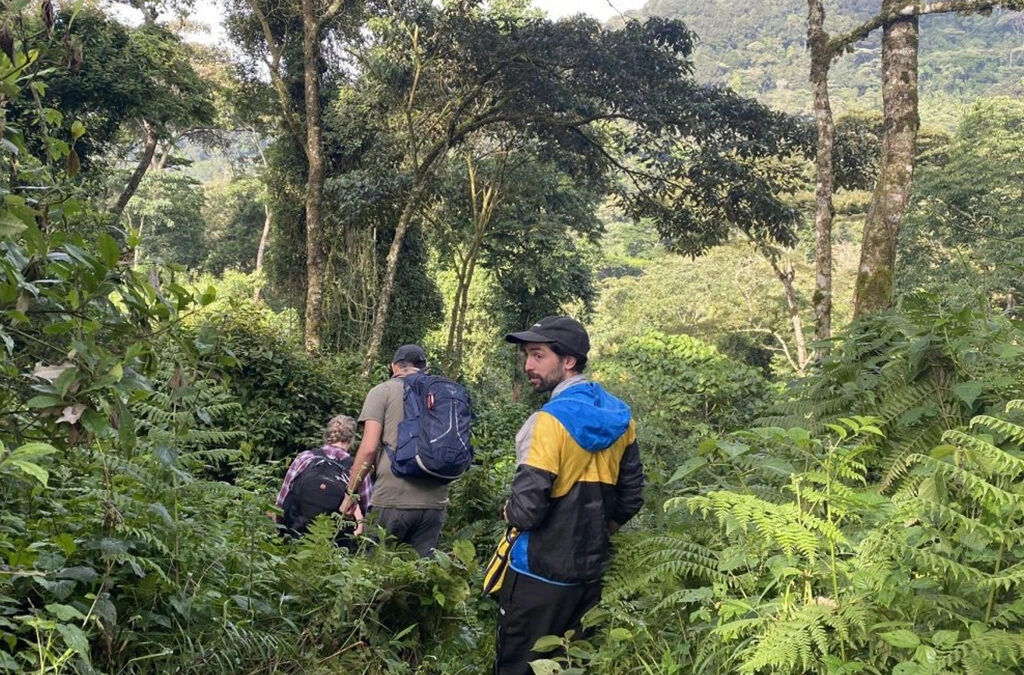
Bwindi Impenetrable Forest National Park. In the misty mountains of southwestern Uganda, draped in ancient cloud forest that has endured for more than 25,000 years, lives one of the rarest and most magnificent creatures on earth — the mountain gorilla. Bwindi Impenetrable Forest National Park is their greatest stronghold, sheltering approximately 459 mountain gorillas, which represents nearly half of the entire global population. It is a UNESCO World Heritage Site, one of Africa’s most biologically rich forests, and the destination that has placed Uganda firmly on the map of the world’s greatest wildlife experiences.
Standing face to face with a mountain gorilla in its natural habitat — watching a silverback move through the undergrowth with effortless power, or seeing a young gorilla tumble playfully through the ferns — is the kind of moment that reshapes how you see the world. It is widely described as one of the most profound wildlife encounters on earth, and no description truly does it justice. At Self Drive Safaris Uganda, we help travellers reach Bwindi with everything they need for a seamless, memorable gorilla trekking safari, including well-equipped 4×4 vehicles and expert route guidance for the journey into Uganda’s breathtaking southwest.
About Bwindi Impenetrable Forest National Park
Bwindi Impenetrable Forest National Park is located in the extreme southwestern corner of Uganda, perched on the edge of the Albertine Rift Valley along the border with the Democratic Republic of Congo. The park spans 321 square kilometers of dense lowland and montane forest across the districts of Kisoro, Kabale, and Kanungu, at elevations ranging from 1,160 metres to 2,607 metres above sea level. Its altitude and rugged terrain give the forest its characteristic misty, atmospheric quality — sunlight filters through the canopy in golden shafts, and the forest floor is a tangle of ancient ferns, mosses, and roots that gave rise to its name.
The park was gazetted as a national park in 1991 and recognised as a UNESCO World Heritage Site just three years later in 1994, a testament to its extraordinary biodiversity and its critical role in protecting one of the world’s most endangered primate species. Bwindi is considered one of Africa’s most ancient forests — it survived the last Ice Age as a refugium when surrounding regions became too cold and arid to sustain forest life, which explains why it harbours an exceptional density of species found nowhere else on earth.
The park is managed by the Uganda Wildlife Authority, which oversees gorilla trekking permits, ranger operations, habituation programmes, and the community conservation initiatives that have helped make Bwindi’s mountain gorilla recovery story one of the greatest conservation achievements of the twenty-first century. The global mountain gorilla population has grown from fewer than 300 individuals in the 1980s to over 1,000 today — a remarkable turnaround driven by sustained protection, community engagement, and the revenue generated by gorilla trekking tourism.
The Mountain Gorillas of Bwindi
The mountain gorilla is the undisputed heart of Bwindi Impenetrable Forest National Park. The park is home to approximately 459 mountain gorillas spread across more than 20 habituated gorilla families, making it the single most important mountain gorilla sanctuary on the planet. These families are distributed across four gorilla trekking sectors — Buhoma, Ruhija, Rushaga, and Nkuringo — and a strict maximum of eight visitors per gorilla family per day is enforced to minimise disturbance and protect the health of the animals.
The gorilla trekking permit for Bwindi costs USD 800 per person for foreign non-residents, issued by the Uganda Wildlife Authority, and includes the one-hour visit with a habituated gorilla family once they have been located by trackers. The chance of encountering a gorilla family on a permitted trek stands at approximately 98%, making the experience almost universally successful. Permits should be booked well in advance — months ahead during the peak dry season months of June to September and December to February — as daily availability is capped at 152 permits across all sectors.
For those seeking an even deeper encounter, the Gorilla Habituation Experience (GHEX) is available exclusively in the Rushaga sector and costs USD 1,500 per person. Unlike the standard one-hour visit, GHEX participants spend up to four hours with a semi-habituated gorilla family alongside researchers and trackers, observing the gorillas’ natural daily movements in real time. It is an extraordinary and intimate experience suited to passionate wildlife enthusiasts and photographers.
The Mubare gorilla group holds a special place in Uganda’s conservation history — it was the very first gorilla family to be habituated for tourism in Uganda, in April 1993, and continues to delight visitors today from the Buhoma sector.
The Four Gorilla Trekking Sectors of Bwindi
One of the most important decisions when planning a Bwindi safari is choosing which sector to trek from, as each offers a distinct landscape, atmosphere, and range of activities beyond gorilla trekking.
Buhoma is the oldest and most established trekking sector, located in the northern part of the park. It is the most accessible from Kampala, offers the most developed tourism infrastructure, and is where Uganda’s gorilla trekking journey began. Buhoma is ideal for first-time visitors and families, with relatively gentle terrain and a wide range of lodges and activities including community village walks, guided forest nature walks, and Batwa cultural experiences.
Ruhija sits in the eastern sector of the park at high elevation and is widely regarded as the finest birdwatching sector in Bwindi. It is less crowded than Buhoma, offering a more peaceful and immersive forest experience. The Mubwindi Swamp trail, accessible from Ruhija, is one of the best spots in all of Uganda to find Albertine Rift endemic bird species.
Rushaga, in the southern part of the park, has the highest number of habituated gorilla families — eight families available for trekking — which means it offers the greatest flexibility for last-minute permit availability. It is also the exclusive home of the Gorilla Habituation Experience, making it the preferred sector for those wanting the deepest gorilla encounter possible.
Nkuringo is the most remote and physically challenging sector, tucked into the southern section of the park with dramatic hillside terrain and sweeping views over the surrounding landscape. The treks here are longer and more demanding, but the sense of adventure and wilderness is unmatched. Nkuringo also borders the community area where Batwa Pygmy encounters can be arranged.
Wildlife and Biodiversity Beyond the Gorillas
Bwindi Impenetrable Forest National Park is far more than a single-species destination. The forest is one of the most biologically diverse ecosystems in all of Africa, sheltering over 120 mammal species, 350 bird species, 310 butterfly species, 200 tree species, and 27 frog species — many of which are found nowhere else on earth. The park’s combination of lowland and montane forest habitats creates ecological conditions that support extraordinary levels of endemism.
Beyond the gorillas, the forest is home to chimpanzees, black and white colobus monkeys, red-tailed monkeys, L’Hoest’s monkeys, olive baboons, and forest elephants, which are occasionally encountered on forest walks. The diversity of primates alone makes Bwindi one of the richest primate forests on the continent.
For birdwatchers, Bwindi is a destination of international significance. Over 350 bird species have been confirmed in the park, including 23 Albertine Rift endemic species — a higher concentration of endemic birds than almost any other forest in Africa. Prized sightings include the African green broadbill, the Shelley’s crimsonwing, the short-tailed warbler, the Bar-tailed trogon, and the handsome francolin, alongside more widespread forest species such as the great blue turaco, black bee-eater, and African emerald cuckoo. Dedicated birdwatching walks in the Ruhija sector and along the Mubwindi Swamp trail are essential for serious birders.
Other Activities at Bwindi Impenetrable Forest National Park
Nature walks and guided forest hikes offer a wonderful way to explore Bwindi’s extraordinary biodiversity between gorilla trekking sessions. The park has numerous well-maintained trails of varying length and difficulty, including the Munyaga Waterfall Trail, the Buhoma-Nkuringo Trail, the Ivy River Trail, the Mubwindi Swamp Trail, and the Rushura Hill Trail. These walks take between two and six hours and pass through dense forest, across rivers, past waterfalls, and up to viewpoints with dramatic panoramas of the surrounding hills and valleys.
The Batwa Cultural Trail is one of the most moving and memorable experiences available anywhere in Uganda. The Batwa Pygmies — the original forest-dwelling inhabitants of Bwindi — were resettled outside the park when it was gazetted, and today they share their extraordinary knowledge of forest life, traditional medicine, hunting techniques, and ancient customs with visitors on guided cultural walks. Spending time with the Batwa provides a profound and deeply human dimension to any Bwindi safari, and the experience directly supports Batwa community livelihoods.
Community walks in and around the Buhoma and Nkuringo areas allow travellers to visit local villages, meet Ugandan families, learn about traditional agriculture and craft-making, and experience the warmth of Ugandan hospitality beyond the forest boundary. These experiences add cultural richness to what is already one of Africa’s most rewarding safari destinations.
Best Time to Visit Bwindi Impenetrable Forest National Park
Bwindi Impenetrable Forest National Park is open for gorilla trekking every day of the year, and the experience is genuinely extraordinary in every season. However, the dry seasons — June to September and December to February — are considered the best time to visit. During these months, the forest trails are drier and less slippery, the vegetation is less dense which can make gorilla encounters slightly easier to photograph, and the overall trekking conditions are more comfortable.
The wet seasons, from March to May and October to November, bring their own rewards. The forest turns a deeper, more vibrant green, the landscapes are strikingly beautiful, and the park is noticeably quieter with more permit availability and lower accommodation rates. Gorilla trekking in the rain has a particular magic — the mist, the silence, and the lushness of the dripping forest create an atmosphere of almost surreal beauty. Waterproof boots and good rain gear are essential for visits at any time of year.
For travellers combining Bwindi with other Uganda destinations such as Queen Elizabeth National Park, Kibale Forest National Park for chimpanzee trekking, or Lake Mburo National Park, the dry season offers the most comfortable overall conditions across multiple parks. Explore our Uganda self-drive safari itineraries to plan the perfect combination route.
How to Get to Bwindi Impenetrable Forest National Park
Bwindi Impenetrable Forest National Park is located approximately 550 kilometres from Kampala, with the road journey typically taking eight to nine hours via Mbarara and Kabale. The route passes through some of Uganda’s most picturesque scenery, including the rolling hills of the Ankole region, the dramatic crater lakes around Fort Portal, and the misty highlands of Kabale — the journey itself is part of the experience.
A 4×4 vehicle with good ground clearance is strongly recommended for the final approaches into Bwindi, particularly during the wet season when the steep hillside roads leading into the trekking sectors can be challenging. Our self-drive 4×4 car hire Uganda service provides vehicles that are fully equipped for the southwestern Uganda roads, giving you complete freedom to travel at your own pace and on your own schedule.
For those preferring to fly, Aerolink Uganda operates scheduled and charter flights from Entebbe to Kihihi Airstrip (serving the Buhoma and Ruhija sectors) and Kisoro Airstrip (serving the Nkuringo and Rushaga sectors), reducing travel time to approximately one hour. Bwindi can also be combined with a Rwanda gorilla trek at Volcanoes National Park — Kigali is roughly four to five hours from Bwindi via the Katuna border crossing, making a cross-border gorilla safari an increasingly popular option.
Where to Stay at Bwindi Impenetrable Forest National Park
Every sector of Bwindi has its own accommodation options across a range of budgets, from wilderness luxury lodges to simple community guesthouses. In Buhoma, Bwindi Lodge and Mahogany Springs Lodge offer luxury experiences on the forest edge, while Buhoma Lodge and Gorilla Safari Lodge provide excellent mid-range options. The Buhoma Community Rest Camp is the most affordable base in the sector.
In Rushaga, the Gorilla Safari Lodge Rushaga and Ichumbi Gorilla Lodge are well-regarded mid-range choices. In Nkuringo, the spectacular Nkuringo Bwindi Gorilla Lodge perches on the Nteko Ridge at 2,161 metres with sweeping views over the park. In Ruhija, Broadbill Forest Camp and Ruhija Gorilla Safari Lodge serve the needs of birdwatchers and trekkers in the eastern sector. Booking accommodation alongside your gorilla permit well in advance is essential, as space is limited across all sectors.
Why Bwindi Impenetrable Forest Is a Once-in-a-Lifetime Experience
Bwindi Impenetrable Forest National Park is not simply one of Uganda’s finest safari destinations — it is one of the most important wildlife sanctuaries on the planet, and visiting it is an act of direct conservation support. Every gorilla permit purchased funds rangers, anti-poaching operations, and the community programmes that make local people active guardians of the forest and the gorillas within it.
The Uganda Tourism Board (www.visituganda.com) promotes Bwindi as Uganda’s flagship wildlife destination, and it is easy to understand why. Nothing quite prepares you for the moment the forest opens up and a gorilla family appears in the undergrowth, going about the quiet business of their ancient lives. That moment — unhurried, unscripted, and deeply wild — is what safari dreams are made of. Explore our full range of Uganda gorilla safari packages and self-drive routes and start planning the adventure that will stay with you forever.
Related posts

Leave a Comment