
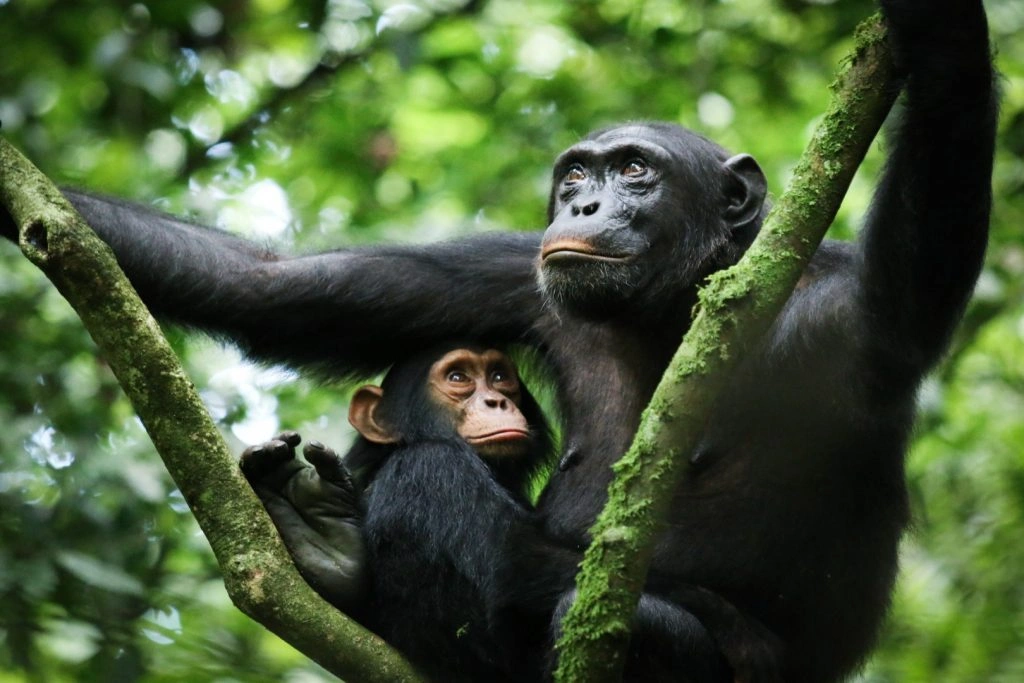
Kibale Forest National Park. Somewhere deep in the mahogany canopy of western Uganda’s most celebrated rainforest, a chimpanzee is calling — a wild, rising shriek that echoes through the trees and sends an electric charge through everyone who hears it for the first time. Following that call, deeper into the forest, moving through shafts of green-gold light that filter through a 55-metre canopy of ancient trees, is one of the most thrilling experiences in all of African wildlife travel. Kibale Forest National Park is the undisputed primate capital of the world, sheltering the highest density of primate life of any forest in East Africa and offering what is widely regarded as the finest chimpanzee trekking experience on the planet.
With over 1,500 chimpanzees living within its boundaries, 13 species of primates, 375 bird species, over 70 other mammal species, and the extraordinary community-run Bigodi Wetland Sanctuary on its doorstep, Kibale is far more than a single-species destination. It is a forest of exceptional completeness, and every hour spent within it — whether tracking chimpanzees at dawn, birding through the undergrowth at midday, or walking the Bigodi boardwalk in the afternoon — rewards the visitor with encounters of rare beauty and intimacy. At Self Drive Safaris Uganda, Kibale Forest National Park is one of our most enthusiastically recommended destinations, and our 4×4 hire service and self-drive itineraries make it easy to reach this magnificent forest at your own pace.
About Kibale Forest National Park
Kibale Forest National Park is located in the Kabarole District of western Uganda, near the regional hub town of Fort Portal, approximately 300 kilometers from Kampala — a journey of four to five hours by road through the rolling green hills of western Uganda. The park covers an area of 795 square kilometers of tropical rainforest, woodland, and wetland, and sits at an altitude of between 1,100 and 1,590 meters above sea level. It was gazetted as a national park in 1993 and is managed by the Uganda Wildlife Authority.
One of the most ecologically significant features of Kibale is its direct connection to Queen Elizabeth National Park to the south. A continuous 180-kilometre wildlife corridor links Kibale’s Sebitoli area in the north to Queen Elizabeth’s Ishasha sector in the south, creating an unbroken protected landscape through which elephants, buffaloes, and other large mammals move freely between the two parks. This corridor is one of the most important for wildlife conservation in the entire region and gives both parks an ecological richness that far exceeds what either could sustain in isolation.
The forest itself is a mosaic of tropical rainforest and moist evergreen forest in the northern and central sections, transitioning to woodland and grassland in the south. Trees of over 351 species rise to form a dense, multilayered canopy in places reaching 55 metres in height, creating a living cathedral of extraordinary biodiversity in which primates, birds, insects, amphibians, and mammals occupy every available niche from the forest floor to the highest branches.
Chimpanzee Trekking at Kibale Forest National Park
Chimpanzee trekking at Kibale Forest National Park is the second most sought-after primate experience in Uganda after gorilla trekking, and for many travellers who have done both, the chimpanzee encounter is the more viscerally exciting of the two. Chimpanzees share approximately 98 percent of their DNA with human beings, and watching them — foraging, grooming, playing, and communicating with an expressive vocabulary of calls, gestures, and facial expressions — provokes a profound and immediate sense of recognition that very few wildlife experiences can equal.
All chimpanzee trekking in Kibale begins at the Kanyanchu Visitor Centre with a morning briefing covering the rules and expectations for the forest visit. Small guided groups are then led into the forest by experienced Uganda Wildlife Authority rangers and guides, following the movements of the chimps — which are tracked from first light by researchers who spend the night identifying where the animals chose to sleep. The search can take anywhere from thirty minutes to three hours depending on where the chimpanzees have moved overnight, and the one-hour visit with the habituated family begins once they are found.
A chimpanzee trekking permit for Kibale Forest National Park costs USD 200 per person for foreign non-residents and should be booked well in advance through the Uganda Wildlife Authority or a registered tour operator, particularly for visits during the peak dry season months of June to September and December to February. The permit grants one hour with a habituated chimpanzee community in their natural forest habitat — an hour that the vast majority of visitors describe as one of the most memorable of their lives.
For those wishing to spend more time with the chimpanzees, the Chimpanzee Habituation Experience offers a full day in the forest with a semi-habituated chimpanzee community alongside researchers and scientists. This extraordinary experience — following the chimps from their sleeping nests at dawn through the full arc of their daily activities — costs USD 300 per person and is available on a limited daily basis. It is the deepest and most immersive chimpanzee encounter available anywhere in Uganda, and provides an extraordinary window into the complex social and behavioural world of our closest living relatives.
The Thirteen Primates of Kibale
Kibale Forest National Park is home to 13 species of primates — more than any other forest in East Africa — making it a destination of global significance for primate research and ecotourism alike. Alongside the chimpanzees, visitors to the park regularly encounter an extraordinary cast of primate species on guided forest walks, boat trips, and nature walks through the park’s various habitats.
The red colobus monkey is one of the most striking and abundant primates in Kibale, occurring in large and noisy troops that move through the upper canopy with remarkable speed and agility. The black-and-white colobus monkey, with its flowing white mantle and dramatic leaping ability, is another spectacular presence in the high forest. The grey-cheeked mangabey — a large, ground-dwelling monkey with a distinctive grey face — is found in good numbers and offers some of the most reliable and close-range encounters of any Kibale primate.
L’Hoest’s monkey, the red-tailed monkey, the blue monkey, olive baboons, and vervet monkeys complete a cast that also includes the secretive potto and the bush baby — both nocturnal species most reliably seen on the park’s guided night walks. The density and diversity of primates in Kibale means that almost any walk in the forest — even a short stroll from the lodge to the visitor centre — is likely to produce multiple primate species without any special effort.
Birdwatching at Kibale Forest National Park
With over 375 confirmed bird species — including a remarkable concentration of Albertine Rift endemics and Central African forest specialists — Kibale Forest National Park is one of the top birding destinations in all of East Africa. The forest’s multilayered canopy, its mosaic of habitats, and its position in the Albertine Rift biodiversity hotspot combine to support a bird community of extraordinary richness and variety.
Among the most celebrated birding highlights are the African pitta and the green-breasted pitta — two of the most brilliantly coloured and highly sought-after forest birds in Africa, both found in Kibale and both reliably sought by dedicated birdwatchers on dawn walks through the forest undergrowth. The African grey parrot, the black bee-eater, the yellow-spotted nicator, the great blue turaco, the white-thighed hornbill, the crowned eagle, and multiple species of greenbul and robin-chat are among the many headline species that reward morning birding walks at the Kanyanchu and Sebitoli tourism sites.
The Sebitoli area in the north of the park is particularly productive for forest birds and is less visited than Kanyanchu, offering a quieter and more exclusive birding experience. Dedicated birdwatching walks can be arranged through the Uganda Wildlife Authority, and a combination of early morning forest walks in Kibale with an afternoon visit to the Bigodi Wetland Sanctuary can yield well over 150 species in a single day — a remarkable total for any birding destination.
Bigodi Wetland Sanctuary: A Community Conservation Triumph
Just six kilometres from the Kanyanchu Visitor Centre, along the Fort Portal-Kamwenge road, lies one of Uganda’s most celebrated and inspiring conservation success stories. The Bigodi Wetland Sanctuary protects the Magombe Swamp — a lush, papyrus-fringed wetland of approximately four square kilometres that supports an extraordinary concentration of birds and primates in a compact and beautifully managed area.
What makes Bigodi remarkable is not just its wildlife — it is the community behind it. The sanctuary is managed by the Kibale Association for Rural and Environmental Development (KAFRED), a grassroots community organisation that channels tourism revenue directly into local schools, healthcare, and community development projects. UNESCO has recognised Bigodi Wetland Sanctuary as an award winner for the best community sustainable tourism project — a distinction that speaks to the extraordinary model it represents for conservation-community integration.
The guided 4.5-kilometre circular trail through the swamp is one of the finest guided wildlife walks in all of East Africa. In the space of a few hours, visitors regularly encounter six or more primate species — red colobus, black-and-white colobus, red-tailed monkeys, grey-cheeked mangabeys, L’Hoest’s monkeys, olive baboons, and blue monkeys — as well as an exceptional diversity of birds. The papyrus gonolek, the papyrus canary, the white-winged warbler, the black bee-eater, the white-thighed hornbill, and the African finfoot are among the swamp’s most prized avian residents, and the boardwalk and viewing platforms along the trail offer superb conditions for photography.
Morning walks beginning at 7:30 am and afternoon walks starting at 3:00 pm are available daily, and the experience perfectly complements a chimpanzee trekking morning in the main park. Combining Kibale and Bigodi in the same visit is one of the most rewarding ways to spend forty-eight hours anywhere in Uganda.
Other Activities at Kibale Forest National Park
Beyond chimpanzee trekking and Bigodi, Kibale Forest National Park offers a compelling range of activities that reward travellers who choose to spend more than a single night in the area.
Guided forest nature walks through the Kanyanchu trail system offer the opportunity to explore the forest at an unhurried pace, learning about its ecology, medicinal plants, and tree species from knowledgeable Uganda Wildlife Authority guides. These walks regularly produce encounters with multiple primate species, forest birds, and the occasional elephant or buffalo in the woodland margins — and the experience of simply being present in one of Africa’s finest tropical forests, beneath a canopy that has endured for thousands of years, is deeply satisfying in itself.
Night walks through the forest after dark are one of Kibale’s most distinctive offerings. Led by rangers with powerful torches, these nocturnal excursions reveal the forest’s nighttime residents — pottos, bush babies, nightjars, tree hyraxes, civets, serval cats, and the occasional porcupine — in a world that feels entirely different from the same paths walked during the day. The chilling shriek of the tree hyrax in the darkness above, and the enormous reflective eyes of a bush baby caught in the torchlight, make the night walk one of the most memorable experiences in the park.
The Ndali-Kasenda crater lake field, located near the park in the highlands above Fort Portal, adds a landscape of extraordinary scenic beauty to any Kibale itinerary. These volcanic crater lakes — set among rolling tea estates and forested hills — are among the most photogenic natural features in western Uganda and make a rewarding afternoon excursion from any of the park’s lodges.
Best Time to Visit Kibale Forest National Park
Kibale Forest National Park is open for chimpanzee trekking and all activities throughout the year, and the chimpanzee encounter is reliable and rewarding in every season. However, the dry seasons — June to September and December to February — offer the most comfortable trekking conditions. During these months, the forest trails are drier and less muddy, forest visibility is generally better, and the overall experience is more physically comfortable for visitors exploring the park on foot.
The wet seasons, from March to May and October to November, bring the forest to its most lush and vibrant green, and the birding is particularly rewarding as many species are in breeding plumage and at their most vocal. The park is significantly quieter during the wet season, and permit availability is easier — making these months an excellent choice for travellers who prefer a less crowded experience and do not mind the possibility of rainfall during walks.
Chimpanzee trekking operates in two daily sessions — morning sessions departing at 8:00 am and afternoon sessions departing at 2:00 pm — meaning the park can be productively visited regardless of how travellers structure their day. Our team at Self Drive Safaris Uganda can help you choose the best timing and build a western Uganda itinerary that combines Kibale with Queen Elizabeth National Park, the Rwenzori Mountains, or Bwindi Impenetrable Forest for gorilla trekking.
How to Get to Kibale Forest National Park
Kibale Forest National Park is located approximately 300 kilometres from Kampala, with the road journey taking four to five hours via Mubende or Fort Portal — two well-maintained routes through the highlands of western Uganda. The park headquarters at Kanyanchu is situated on the Fort Portal-Kamwenge road, approximately 36 kilometres south of Fort Portal town, and the road is in good condition for most of the year.
Fort Portal is a well-serviced regional town with good hotels, restaurants, fuel stations, and ATMs, and it serves as the natural base for travellers visiting Kibale, the nearby Semuliki National Park, and the crater lake region. A 4×4 vehicle is recommended for travel in the area, particularly during the wet season when roads within and around the park can become slippery. Our self-drive 4×4 car hire Uganda service includes vehicles ideally suited to western Uganda’s roads, giving independent travellers complete freedom to explore the region on their own terms.
For those preferring to fly, Aerolink Uganda operates domestic flights from Entebbe to Kasese Airstrip — the closest airfield — from where the park is approximately one hour by road. Kibale is also an excellent midpoint on any western Uganda circuit between Murchison Falls National Park to the north and Bwindi Impenetrable Forest or Queen Elizabeth National Park to the south. Explore our Uganda self-drive safari itineraries for inspiration on planning the perfect western Uganda journey.
Where to Stay at Kibale Forest National Park
Kibale Forest National Park and its surroundings offer an excellent range of accommodation options across all budgets. Primate Lodge Kibale is the park’s premier luxury option — nine exquisite forest cottages set within the park boundary itself, offering direct forest access and an atmosphere of total immersion in the natural environment. Ndali Lodge, perched above one of the crater lakes with sweeping views across the western Uganda highlands, is another outstanding luxury choice that combines exceptional scenery with easy access to the park.
For mid-range travellers, Kibale Forest Camp offers comfortable tented accommodation in a beautiful forest setting, while Chimp’s Nest and Turaco Treetops provide welcoming and well-located alternatives near the park entrance. Budget travellers are well served by the Uganda Wildlife Authority Rest Camp at Kanyanchu and the range of guesthouses available in Fort Portal town. The variety of options makes Kibale one of the most accessible and flexible parks in Uganda for travellers at every price point.
Why Kibale Forest National Park Is an Essential Uganda Safari Destination
Kibale Forest National Park is, quite simply, one of the greatest primate destinations on earth. The density and diversity of its primate life — led by the largest protected chimpanzee population in East Africa — sets it apart from any comparable forest destination on the continent. Combined with world-class birding, the community conservation triumph of Bigodi Wetland Sanctuary, dramatic crater lake scenery, and a range of forest activities that reward every type of traveller, Kibale delivers an experience of extraordinary completeness.
The Uganda Tourism Board consistently highlights Kibale as one of Uganda’s flagship safari destinations, and every traveller who spends a night in the forest and wakes before dawn to follow the sound of calling chimpanzees through the trees understands immediately why.
Start planning your Kibale Forest safari today with our full range of Uganda self-drive safari packages and 4×4 car hire options and let us help you experience the forest that the whole world comes to Uganda to see.
Related posts


Leave a Comment