
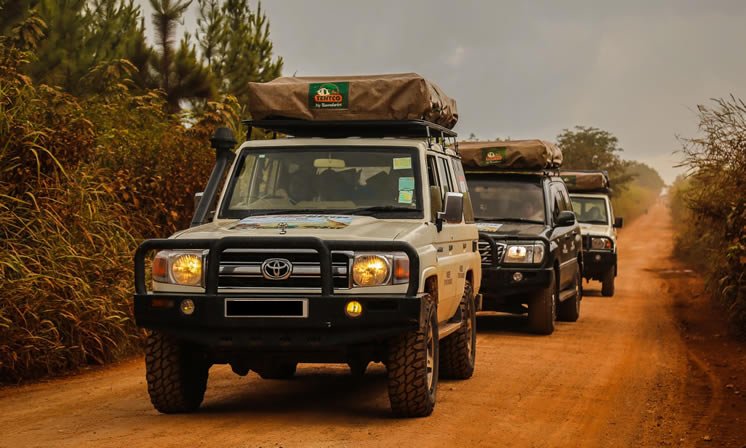
Self drive semliki national park.Semliki National Park is the most unusual and most undervisited national park in Uganda — a hot, ancient lowland rainforest pressed against the Democratic Republic of Congo border at the base of the Rwenzori Mountains in the Albertine Rift Valley, sheltering bird species found nowhere else in Uganda and geological features that belong to a different Africa from the savannah parks that dominate most Uganda safari circuits. The forest is a direct extension of the Ituri Forest in Congo, one of Central Africa’s most ancient and biologically rich ecosystems, and the species it harbours reflect that Central African heritage — more than 440 bird species including over 50 recorded nowhere else in Uganda, primates characteristic of the Congo basin, and the boiling Sempaya Hot Springs that have been bubbling from the earth at temperatures exceeding 103 degrees Celsius since long before the park existed. For self drive visitors who want the most off-circuit, least-touristy, most genuinely wild national park in Uganda, Semliki is the destination that rewards the effort of getting there with an experience entirely unlike any other Uganda park. This complete Semliki self drive guide covers the approach road from Fort Portal, the park’s principal attractions, what to expect on a self drive visit, vehicle requirements, the best time to come, and how Semliki fits into the Fort Portal region circuit. Browse our Uganda self drive packages and car hire and self drive options for vehicle and itinerary planning.
The Approach from Fort Portal — The Rwenzori Escarpment Road
The drive from Fort Portal to Semliki National Park is one of the most dramatic and most technically demanding day drives in Uganda, and understanding it is essential for self drive planning. From Fort Portal, the road heads west and north toward Bundibugyo, climbing into the Rwenzori foothills before the escarpment road descends in a series of steep, winding switchbacks from the highland plateau down into the Semliki Valley below — a descent of roughly 1,200 metres in altitude over a short horizontal distance, with extraordinary views of the Congo basin spreading westward below on clear days. The total distance from Fort Portal to the Semliki National Park gate near Ntandi is approximately 52 kilometres, but the escarpment road’s gradient, tight corners, and surface condition mean the drive takes two to three hours rather than the hour a flat road of equivalent distance would require. In the dry season — June through September and December through February — the escarpment road is demanding but entirely navigable in a properly equipped 4×4. In the wet season, the steep sections become significantly more challenging as the laterite surface softens and traction requirements increase sharply — wet-season Semliki is Prado or Land Cruiser V8 territory, with low-range four-wheel drive required on several sections of the descent. From the park gate, the tracks into Semliki’s forest interior follow the valley floor to the Sempaya Hot Springs and the principal forest walk trailheads on surfaces that stay challenging throughout the year. A Toyota Land Cruiser Prado from our self drive fleet is the recommended vehicle for any Semliki itinerary, and any season.
Sempaya Hot Springs — Semliki’s Geological Centrepiece
The Sempaya Hot Springs are Semliki’s most visited and most visually extraordinary attraction — two boiling geothermal vents set within the forest interior where superheated water erupts continuously from the earth at temperatures that cook eggs in minutes and send columns of steam into the forest canopy above. The springs are accessible on a short guided walk from the Sempaya car park — approximately thirty to forty-five minutes each way through riverine forest — with Uganda Wildlife Authority rangers leading the way and providing geological and ecological context throughout. The two springs are traditionally known as the male spring (Bintente) and the female spring (Nyasimbi), and each presents differently — the female spring is the larger and more dramatic, a boiling pool several metres across where the water erupts and bubbles continuously in a display that has no equivalent in Uganda and few in East Africa. The forest walk to the springs passes through some of Semliki’s finest riverine habitat, and birding along the trail to Sempaya is among the finest hour of birdwatching available anywhere in Uganda, with Central African forest species dropping into view at the forest edge and along the riverbank. The springs are best visited in the morning when light penetrates the forest and temperatures in the valley are still manageable — the Semliki Valley is hot year-round, and afternoon heat in the lowland forest is significant.
Birding at Semliki — Why Specialist Birders Make the Journey
Semliki is the most important birding site in Uganda for species with a Congolese or Central African distribution, and serious birders throughout Africa consider a Semliki visit a defining tick for a Uganda bird list. The park’s position as a western Uganda outlier of the Central African rainforest ecosystem means that it holds species which simply do not occur in any of Uganda’s other national parks — the African piculet, Nkulengu rail, white-crested hornbill, red-billed dwarf hornbill, African dwarf kingfisher, black dwarf hornbill, and forest robin among many others. The African piculet is the bird that draws the most dedicated interest — a tiny, technically difficult species that moves fast through dense understorey and requires local knowledge and patience to find — and Uganda Wildlife Authority rangers at Semliki are experienced at locating it on a dedicated birding walk. Over 440 species have been recorded in the park, combining the Central African forest specialists with the Albertine Rift endemics that the escarpment habitat on the approach road provides before you even enter the park. For self drive birding visitors, the drive from Fort Portal to the park gate passes through escarpment forest that holds additional Albertine Rift species in a zone distinct from the hot valley forest below, effectively delivering two different bird habitat types on the same day.
Wildlife and Forest Walks Beyond the Hot Springs
Beyond the Sempaya Hot Springs walk, Semliki offers Uganda Wildlife Authority ranger-guided forest walks that penetrate deeper into the lowland rainforest interior — habitat that shelters forest elephants (present but highly elusive in the dense understorey), chimpanzees (present throughout the forest but not habituated for trekking in the way that Kibale Forest’s Kanyanchu community is), red colobus monkeys, olive colobus, black and white colobus, de Brazza’s monkeys, and the grey-cheeked mangabeys that are common throughout western Uganda’s forest parks. The forest walks vary in length and are arranged with the Uganda Wildlife Authority rangers at the park gate — morning departures are best for wildlife activity before the valley heat builds. Semliki also provides the opportunity to visit a Batwa community near the park boundary — the Batwa are the indigenous forest people of this region, and community visits arranged through local organisations near Bundibugyo provide cultural context for the forest landscape that the wildlife encounters alone cannot convey.
Self Drive Preparation — What Semliki Demands
Semliki requires more careful self drive preparation than any other park in the Fort Portal region, and the preparation considerations go beyond vehicle choice. The escarpment road has no fuel stations between Fort Portal and Bundibugyo — fill completely in Fort Portal before departure and carry a fuel reserve if your circuit extends beyond Semliki without returning to Fort Portal immediately. Mobile phone coverage is limited in the Semliki Valley and non-existent in sections of the escarpment road, making the offline GPS maps on your rental vehicle device particularly important on this route — download the Semliki Valley tracks before departing Fort Portal. The valley’s lowland position and hot humid climate create a high malaria risk zone that is more intense than Uganda’s highland parks — ensure antimalarial medication is current and that long-sleeved clothing and repellent are in the vehicle for the forest walk. Carry sufficient water for the hot springs walk and forest walks — the valley heat and humidity dehydrate faster than the highland parks. Our best 4×4 car hire deals include vehicles prepared with offline GPS loaded for Semliki Valley routing and the full western Uganda circuit.
Combining Semliki with the Fort Portal Region Circuit
Semliki sits most naturally within a Fort Portal region circuit that combines it with Kibale Forest and the Fort Portal crater lakes — a three to four day self drive exploration of the Fort Portal Tourism Area that provides chimpanzee trekking at Kibale, the hot springs and Central African birding at Semliki, and the extraordinary crater lake scenery of the Fort Portal plateau within a self-contained western Uganda loop. Queen Elizabeth National Park connects naturally to the south of Fort Portal for visitors whose circuit extends further, and Murchison Falls National Park is accessible to the northeast for a longer northern extension. Semliki is not commonly included in shorter Uganda circuits because its position requires a dedicated detour from the Fort Portal base — the escarpment road does not form part of a logical through-route between other parks, so the visit requires a deliberate out-and-back day from Fort Portal or an overnight at one of the lodges near the park gate. For self drive visitors with the time and vehicle for it, that deliberate detour is entirely worth making — Semliki delivers a Uganda that the main circuit parks simply cannot replicate. Browse our full Uganda self drive packages, view our 7-day Uganda tour for a Fort Portal-based circuit framework, or contact our team today to plan your Semliki self drive with the right vehicle and a Fort Portal circuit that does justice to western Uganda’s most extraordinary corner.
Related posts

Leave a Comment