
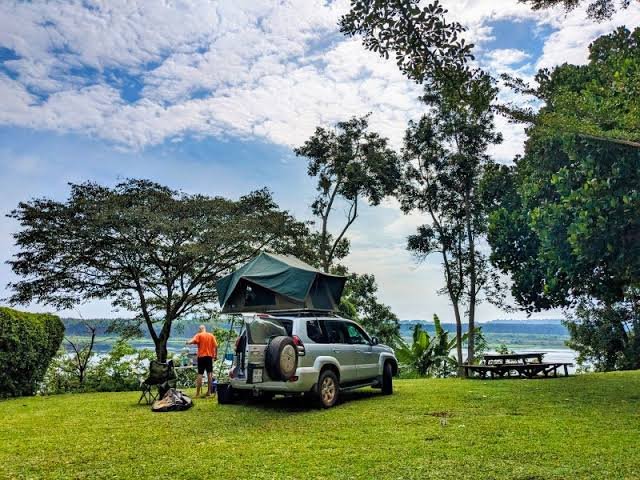
Rooftop tent safaris Uganda.A rooftop tent safari in Uganda is the purest expression of the self drive camping format — a 4×4 vehicle with a folding tent mounted directly on the roof rack, a mattress already inside, and the ability to pull off a game circuit track at the end of an extraordinary wildlife day and sleep elevated above the ground on top of your vehicle in the middle of one of Africa’s most biologically diverse national parks. The rooftop tent transforms the self drive vehicle from a transport and game viewing platform into a complete mobile camp — every campsite becomes accessible, every early morning game drive departs from exactly the spot where you slept, and the experience of waking at first light in a rooftop tent with the sounds of a Uganda national park assembling below you is something that no lodge room, however well positioned, can replicate. Rooftop tents are widely established in Southern Africa’s overland safari culture and are a growing option on Uganda’s self drive circuit, where the combination of Uganda’s exceptional campsite locations — the Nile bank at Murchison, the Kazinga Channel shore at Queen Elizabeth, the Bwindi forest edge at Buhoma — and the rooftop tent’s elevation above ground-level wildlife activity creates a camping experience of particular intensity and particular safety. This complete guide covers what rooftop tent safari in Uganda involves, why the elevated format works especially well in Uganda’s specific wildlife environment, the best Uganda campsites for rooftop tent camping, vehicle choice for RTT camping, and how to build a rooftop tent circuit that covers Uganda’s finest camping destinations. Browse our Uganda self drive packages and car hire and self drive options for RTT rental and itinerary support.
Why Rooftop Tents Work Especially Well in Uganda
The rooftop tent’s principal advantage — sleeping elevated above ground level rather than on the earth itself — is relevant in any camping destination but is particularly valuable in Uganda’s national park environment, where the wildlife that approaches campsites at night includes species that demand a different level of night awareness than the average European or North American campsite. Hippos leave the water after dark to graze on park grassland and regularly pass through or near campsites positioned on Nile and channel banks — Red Chilli Rest Camp at Murchison Falls, the Mweya camping area at Queen Elizabeth, and the Ishasha wilderness camp in the park’s southern sector all host regular nocturnal hippo activity. A rooftop tent camper sleeps two metres above the ground on a stable platform, entirely removed from the hippo’s ground-level grazing circuit, and the psychological comfort of that elevation — while not eliminating all wildlife encounter risk — produces the kind of relaxed sleep that ground tent camping in hippo country cannot quite deliver. Elephants that pass through camping areas at night, hyenas investigating food smells, and the general nocturnal wildlife traffic of a Ugandan national park are all experienced from the rooftop tent as sounds and proximity rather than as immediate ground-level encounters. For couples and solo travellers who want to self drive camp in Uganda without the anxiety that ground-level camping in a genuinely wild environment can produce, the rooftop tent is the camping format that delivers the experience without compromising the sleep.
The Best Uganda Campsites for Rooftop Tent Camping
Uganda’s national park campsite network is well-suited to rooftop tent camping, and the best RTT sites combine accessible parking flat enough to sleep comfortably on the vehicle, genuine wildlife proximity, and facilities adequate for the cooking and ablution needs of self-sufficient campers. At Murchison Falls National Park, Red Chilli Rest Camp on the southern Nile bank is the most convenient RTT base — flat parking, ablution blocks, a bar and restaurant for evenings when cooking is not the priority, and Nile hippo activity audible from the tent roof throughout the night. The Uganda Wildlife Authority campsites on Murchison’s northern bank at Buligi provide the most immersive RTT experience on the game circuit itself — parking the vehicle at the site, sleeping in the RTT, and departing directly onto the northern bank game tracks at first light without a ferry wait is the most wildlife-productive Murchison morning possible. At Queen Elizabeth National Park, the Mweya hostel camping area on the peninsula provides a Kazinga Channel Nile view campsite with ablution facilities and the channel wildlife activity — hippos, crocodiles, and waterfowl — immediately below the site. The Ishasha wilderness campsite in Queen Elizabeth’s southern sector places RTT campers within the tree-climbing lion territory on the banks of the Ishasha River — one of the most extraordinary campsite locations in Uganda. At Bwindi Impenetrable National Park, the Buhoma Community Rest Camp provides forest-edge camping with the forest sounds — chimpanzees calling in the canopy, birds, insects — as the overnight soundtrack in a setting that prepares gorilla trekkers for the forest encounter the following morning. At Kidepo Valley National Park, Apoka Rest Camp is the RTT base for Uganda’s most remote and most rewarding northern circuit, with lions and buffalo regularly visible from the campsite in the dry season.
Vehicle Choice for Rooftop Tent Safari in Uganda
The Toyota Land Cruiser Prado is the preferred vehicle for rooftop tent safari in Uganda, and the preference is rooted in practical engineering rather than brand loyalty. An RTT with its integrated mattress and occupants adds significant weight and height to the vehicle — a fully loaded two-person RTT can add 80 to 120 kilograms to the roof rack — and the Prado’s stronger chassis, wider track, lower centre of gravity relative to its height, and more robust roof rack mounting points handle this load more comfortably than the RAV4 Safari on Uganda’s rougher game circuit tracks. The Prado’s additional height, which the roof-mounted tent increases further, requires careful awareness of overhead branches on forest approach roads — the Bwindi forest tracks in particular and the Kibale approach roads have low canopy sections where RTT vehicle height demands reduced speed and careful line selection. The Prado’s greater load capacity also accommodates the full self-sufficient camping kit — water containers, cooking equipment, food supplies, and personal gear — alongside the RTT weight without compromising the vehicle’s performance on Uganda’s more demanding tracks. Our self drive fleet includes Prado configurations with roof rack mounting points suited to RTT installation, and our team advises on the optimal RTT-vehicle combination for each circuit at the point of booking.
What a Complete Rooftop Tent Rental Package Includes
A rooftop tent rental package for a Uganda self drive circuit should include the tent itself — either a soft-shell fold-out style or a hard-shell flip-top, both of which deploy in under two minutes — with its integrated foam mattress already fitted inside. Bedding — sleeping bag rated for Uganda’s overnight temperatures, which can drop to 12 to 15 degrees Celsius at Bwindi and Kidepo’s higher elevations even in dry season — is either included in the RTT package or brought by the visitor, and this should be confirmed at the time of booking. An aluminium access ladder is built into the tent’s fold-out mechanism and deploys with the tent for sleeping access and overnight ablution descents. The full vehicle package alongside the RTT should include the standard self drive rental documentation set: offline GPS with Uganda campsite locations pre-loaded, comprehensive insurance, and 24-hour roadside assistance covering the remote campsite locations where an RTT breakdown creates more complex recovery logistics than a roadside failure.
Building a Uganda Rooftop Tent Circuit
The Uganda circuit that delivers the finest sequence of rooftop tent camping experiences runs from Entebbe northwest to Murchison Falls for two nights on the northern bank and at Red Chilli, then south to Queen Elizabeth for the Mweya peninsula and Ishasha, then east to Bwindi for a Buhoma forest-edge camping night before the gorilla trek, then north through Kabale to Lake Bunyonyi for a rest night before returning to Entebbe. Ten days covers this circuit at a pace that allows genuine game drive time at each park rather than rushed transit camping. For visitors with time for Uganda’s full northern extension, Kidepo Valley adds the Apoka Rest Camp experience and the most remote RTT nights in Uganda to the circuit. Browse our best 4×4 car hire deals for current RTT-equipped vehicle rates, explore our Uganda self drive packages for circuit frameworks, or contact our team today to configure a rooftop tent safari matched to your circuit, travel dates, and budget.
Related posts

Leave a Comment