
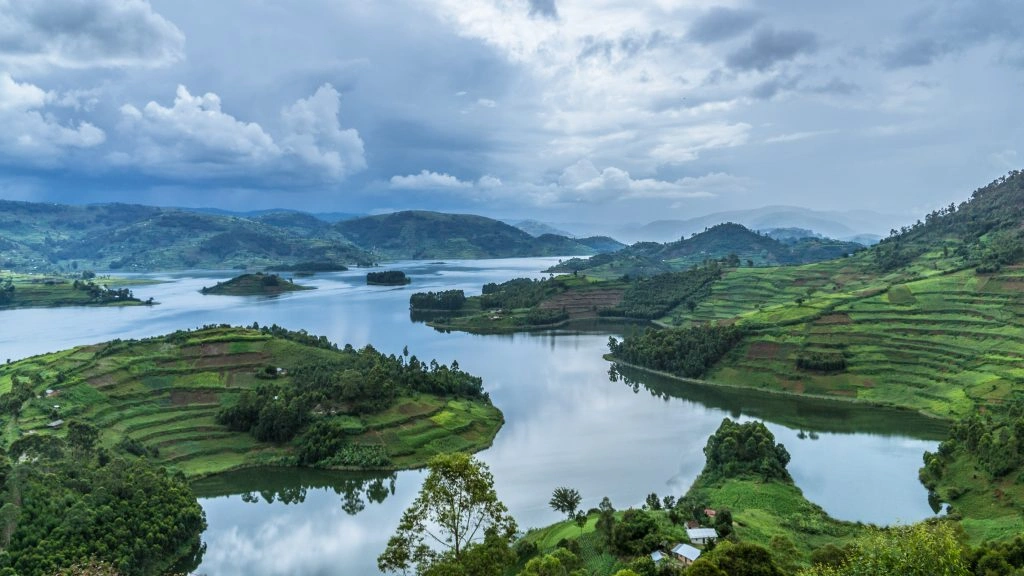
Kigali to lake bunyonyi road trip.The drive from Kigali to Lake Bunyonyi is the shortest and most rewarding cross-border road trip available from Rwanda’s capital — a journey of approximately 100 kilometres that takes two and a half to three hours including the Katuna–Gatuna border crossing, and delivers you to one of the most scenically extraordinary lakes in Africa before the afternoon is over. Lake Bunyonyi sits at 1,962 metres above sea level in Uganda’s Kigezi highlands, six kilometres west of Kabale town — a deep, island-scattered, brilliantly green lake surrounded by steep terraced hillsides that drop from the escarpment to the water’s edge in a landscape of extraordinary intensity. The name Bunyonyi means “place of many little birds” in the local Rukiga language, and the lake’s sheltered bays, papyrus fringes, and highland forest remnants make it one of Uganda’s finest birding sites as well as one of its most visually memorable destinations. For self drive visitors based in Kigali — whether on a Rwanda posting, a short Rwanda stay, or a cross-border circuit that has just begun — Lake Bunyonyi represents the nearest and most compelling reason to cross the border into Uganda. This complete guide covers the road from Kigali to the lake, the border crossing process, what Lake Bunyonyi offers, activities on and around the water, and how the lake connects to the wider Uganda circuit that most visitors continue into from this spectacular highland base. Browse our car hire and self drive options and Uganda and Rwanda packages for vehicle and itinerary support.
The Drive from Kigali to Gatuna — Rwanda’s Southern Landscape
From Kigali, the road to the Gatuna–Katuna border runs south and southwest through Rwanda’s gently rolling southern highlands — a drive of approximately 85 kilometres from the city centre that takes one hour to one and a half hours on a well-maintained tarmac road. The route passes through the agricultural heart of southern Rwanda, where the terraced hillsides are cultivated to their ridgelines in a landscape that is greener and more intensively farmed than Rwanda’s volcanic northwest, with banana plantations, tea estates, and sorghum fields defining the visual rhythm of the approach to the border. The town of Huye — Rwanda’s academic capital and a worthwhile stop in its own right for the National Museum of Rwanda — lies approximately 130 kilometres south of Kigali on an alternative routing that adds some distance but passes through southern Rwanda’s finest scenery before swinging west toward Gatuna. For visitors making a direct Kigali to Lake Bunyonyi run, the main Kigali to Gatuna road is the faster choice; for those combining the road trip with a southern Rwanda detour through Nyungwe Forest National Park, the longer southern arc creates a full Rwanda day before the Uganda crossing. Fill up with fuel completely in Kigali before departure — Rwanda’s southern approach to Gatuna has fuel available in Huye if the longer route is used, but the direct route has limited stops between the city and the border.
The Katuna–Gatuna Crossing and the Entry into Uganda
The Katuna–Gatuna crossing is the most commonly used border between Rwanda and Uganda for safari visitors and is well-organised for tourist self drive vehicles in both directions. Exit Rwanda at the Gatuna Immigration post on the Rwanda side, cross the neutral zone, and enter Uganda at the Katuna post — presenting your passport, driving licence, International Driving Permit, vehicle registration, hire company cross-border authorisation letter, and East African Community yellow card insurance certificate to the officials on both sides. The crossing takes thirty to sixty minutes in normal conditions with a complete document set. The critical adjustment as you depart the Uganda Immigration compound is the traffic direction switch — from Rwanda’s right-hand traffic to Uganda’s left-hand traffic — which must be made consciously at the moment of departure and maintained deliberately through the first kilometres of Uganda driving. From the crossing, Kabale town is eight kilometres on a well-surfaced road, and Lake Bunyonyi is six further kilometres west of Kabale on a road that descends from the highland town to the lake’s eastern shore through increasingly dramatic terraced hillside scenery. The entire drive from the border to the lake takes twenty to twenty-five minutes, and the first view of the lake from the road above its eastern shore — islands scattered across deep blue water with the steep green hills reflected in the surface below — is one of those African moments that stops the drive entirely.
Lake Bunyonyi — What Makes It Extraordinary
Lake Bunyonyi is one of the deepest lakes in Africa — estimates of its depth range from 44 to 900 metres depending on the measurement zone — and one of the rare large lakes on the continent that is safe to swim in without the bilharzia risk, hippo danger, or crocodile presence that makes most African lakes dangerous for unprotected water contact. This combination of extraordinary depth, island scenery, and genuine swimming safety makes it uniquely relaxing among Uganda’s natural attractions — a place where self drive visitors genuinely stop, stay longer than planned, and leave with the lake having displaced every other Uganda destination in memory. The 29 islands scattered across the lake’s surface vary from tiny, uninhabited rocky outcrops to larger islands with communities, schools, and the extraordinary Bwama Island — once home to a colonial-era leprosy colony and now an island community accessible by canoe across the water from the main eastern shore. The lake’s elevation keeps temperatures reliably cool even in Uganda’s hottest seasons, and the morning light over the water as mist rises from the surface and the terraced hills glow in the early sun is one of the most beautiful natural spectacles in East Africa.
Activities on and Around the Lake
Lake Bunyonyi’s activities are water-centred in a way that most Uganda national park destinations are not, and the variety of what the lake offers makes it more than a scenic overnight stop. Dugout canoe and kayak hire is available from accommodation on the eastern shore, and paddling between the nearer islands in the morning — when the water is typically calm and the birdlife is most active — is the most atmospheric way to experience the lake’s scale and its island character. Birding from a canoe on the lake or walking the vegetated shores delivers an outstanding species list including grey crowned cranes, African fish eagles, malachite kingfishers, papyrus warblers, and numerous herons and egrets working the shallow bays. Swimming from accommodation jetties and designated lake entry points is the activity that surprises most first-time visitors — the freedom to simply enter the water without anxiety is genuinely unusual in the African Great Lakes region and contributes to the lake’s deeply restorative atmosphere. Guided cultural walks from the eastern shore into the surrounding hillside communities provide context for the Kigezi highland farming culture, the terracing tradition that has shaped this landscape for centuries, and the historical significance of the lake’s islands in the region’s history.
Lake Bunyonyi as a Circuit Base
Lake Bunyonyi’s position in the Kigezi highlands makes it a natural base for the southwestern Uganda circuit, and most self drive visitors who arrive from Kigali use it as the first Uganda overnight stop before continuing to the wider park circuit. From the lake, Bwindi Impenetrable National Park for gorilla trekking is approximately 40 to 80 kilometres depending on the sector — Buhoma in Bwindi’s north is the closest major sector from Kabale, making the Lake Bunyonyi to Buhoma drive a manageable morning transfer before an afternoon arrival. Mgahinga Gorilla National Park is approximately 90 kilometres southwest of Kabale toward the Uganda-Rwanda-DRC border — reachable in under two hours for visitors whose circuit includes a Mgahinga golden monkey tracking or gorilla trekking day. Queen Elizabeth National Park is approximately 200 kilometres northwest on the road through Mbarara and Kasese — a morning drive from Lake Bunyonyi that positions visitors at Mweya for an afternoon Kazinga Channel boat cruise and the following morning’s Kasenyi Plains game drive. Our 2-day Uganda gorilla safari starting from Rwanda uses the Kigali to Bwindi routing via Kabale that passes directly through the Lake Bunyonyi area, and our 10-day Rwanda Uganda safari builds the Lake Bunyonyi overnight into the circuit as a natural highland recovery day between the border crossing and the Bwindi gorilla trek. Browse our full self drive packages, explore our best 4×4 car hire deals, or contact our team today to plan your Kigali to Lake Bunyonyi road trip with the right vehicle and a Uganda circuit that begins at one of the continent’s most beautiful lakes.
Related posts

Leave a Comment