
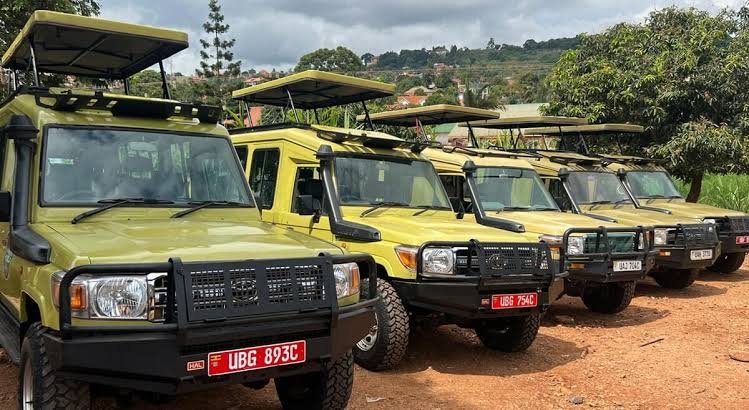
Best vehicles for Uganda safaris.The vehicle a self drive visitor chooses for a Uganda safari shapes every aspect of the circuit experience — from the roads it can access to the daily driving comfort on six-hour transfer days, the fuel cost across 1,200 kilometres, the ability to complete Bwindi’s escarpment approach without incident, and the ground clearance that separates a controlled murram road crossing from a vehicle bottomed out on a Kidepo approach track. Uganda rewards correct vehicle specification more decisively than most East Africa safari destinations because the range of road conditions encountered across a full circuit is wider here than elsewhere — from the excellent tarmac of the Kampala to Mbarara highway to the demanding switchback descent to Bwindi’s Nkuringo sector — and the vehicle that handles one end of this range does not automatically handle the other. This guide covers the three principal vehicles available in Uganda’s self drive fleet, why Toyota dominates Uganda’s safari vehicle market, and a park-by-park breakdown of which vehicle is right for which destination. Browse our self drive fleet and car hire and self drive options for current vehicle availability across the full Uganda circuit.
Why Toyota Dominates Uganda’s Safari Vehicle Fleet
Uganda’s safari rental fleet is overwhelmingly Toyota for reasons that extend beyond brand preference into practical mechanics: Toyota’s Land Cruiser family and the RAV4 have the most widespread spare parts network in East Africa, the largest pool of qualified mechanics, and the longest proven track record on Uganda’s specific combination of tarmac highway, murram approach road, and park game circuit. When a rental vehicle develops a mechanical issue on the Murchison road or near Fort Portal, a Toyota’s parts are available at the nearest town with a reasonable chance of same-day repair; a vehicle from a less-established brand in Uganda’s fleet creates a waiting-for-parts situation that a self drive visitor in a park area cannot resolve quickly. The consistency of Uganda’s Toyota-based rental fleet also means that guidance on vehicle handling, tyre change procedures, and mechanical warning signs is reliable across vehicles — the Prado that a self drive visitor collects in Kampala handles identically to the one driven on a previous Uganda circuit, which is not something that can be said of a mixed-brand fleet. Our self drive fleet is built on this Toyota foundation for exactly these practical reasons.
The Toyota RAV4 Safari — Uganda’s Accessible Entry Point
The Toyota RAV4 Safari is the most affordable 4×4 in Uganda’s self drive fleet and the right vehicle for circuits whose road demands stay within its capability envelope. The RAV4 handles Uganda’s main tarmac highway network without difficulty, accesses Kibale Forest National Park on the Fort Portal approach road, manages Queen Elizabeth National Park’s main Kasenyi and Mweya circuits in dry season, and covers Lake Mburo’s well-compacted game circuit in any season. Its lower daily hire rate and better fuel economy relative to the Prado make it the more economical choice for circuits where those road conditions are the limit of the terrain encountered. The RAV4’s limitations in Uganda become significant on any approach road where gradient, surface softness, and track narrowness combine — Bwindi’s Rushaga, Ruhija, and Nkuringo approaches in any condition, Semliki’s escarpment road year-round, and any Uganda murram road after sustained wet-season rainfall. The RAV4’s shorter wheelbase and lower ground clearance are assets in Uganda’s town driving and market area navigation, where the Prado’s larger dimensions require more care; they become limitations on the approach roads where those same dimensions provide critical capability. The practical rule for RAV4 specification: confirm that every road on the planned circuit is tarmac or well-compacted dry-season murram before choosing the RAV4 over the Prado.
The Toyota Land Cruiser Prado — Uganda’s Benchmark Safari Vehicle
The Toyota Land Cruiser Prado is Uganda’s benchmark self drive safari vehicle — the specification that handles the complete Uganda circuit without restriction, from the tarmac highway legs to the Bwindi sector approaches, the Semliki escarpment, and the Kidepo northern road. The Prado’s turbocharged diesel engine provides the low-rev torque that Uganda’s long highway transfers and steep murram climbs both demand: the same engine characteristic that delivers effortless 80km/h highway cruising without strain also powers the vehicle through a Bwindi approach road gradient in low-range four-wheel drive without the mechanical stress that a smaller engine accumulates on the same section. The Prado’s 87-litre fuel tank provides exceptional range — up to 600 kilometres per tank in combined driving conditions — covering the longest Uganda transfer days without requiring a fuel stop at an inconvenient point on the route. The driving seat position, suspension tuning, and air conditioning capacity of the Prado are all calibrated for the sustained daily driving that Uganda’s multi-park circuits require, and the accumulated difference between the Prado and the RAV4 over a ten-day circuit of six-hour transfer days is felt in the driver’s physical condition by day seven. For any Uganda circuit that includes Bwindi, wet-season travel, or remote park access, the Prado is the appropriate vehicle without qualification.
The Toyota Land Cruiser V8 — Maximum Capability for Demanding Circuits
The Toyota Land Cruiser V8 — the 200-series Land Cruiser — is Uganda’s most capable self drive vehicle and the right choice for the circuit’s most extreme terrain and the largest passenger and luggage loads. The V8’s engine delivers more torque than the Prado at every point in the rev range, which matters most on the Nkuringo escarpment descent, the Kidepo Valley approach road in wet conditions, and any sustained climbing on soft murram where the Prado works perceptibly harder than the V8. The V8’s third-row seating in its seven-seat configuration accommodates larger groups or families without the compression that fitting five or six people into a five-seat Prado creates on long transfer days. The V8’s trade-off is fuel consumption — at 14 to 16 litres per 100 kilometres, it is meaningfully more expensive to run than the Prado across a 1,200-kilometre combined circuit — and its higher daily hire rate. For groups of five or more, the V8’s greater interior volume and luggage capacity frequently make it the more economical per-person option despite the higher vehicle rate; for couples and small groups, the Prado’s combination of capability and fuel economy is the better value across all but the most extreme Uganda circuit terrain.
Park-by-Park Vehicle Guide
Queen Elizabeth National Park is accessible to both the RAV4 and the Prado on the main Kasenyi, Mweya, and Kazinga game circuits; the Ishasha sector’s southern game tracks are manageable in a RAV4 in dry season but benefit from the Prado’s additional clearance in wet conditions. Murchison Falls National Park’s southern bank approach road and main northern bank Buligi circuit are RAV4-accessible in dry season; the delta tracks northwest of Buligi and any northern bank driving in wet season require the Prado. Kibale Forest National Park is tarmac-accessed from Fort Portal and the Kanyanchu visitor centre is a RAV4-accessible destination in all seasons — one of the few Uganda forest parks where vehicle specification is not a constraint. Bwindi Impenetrable National Park requires the Prado for all four sectors in all seasons, with the V8 the better choice for Nkuringo in wet conditions. Kidepo Valley National Park requires the Prado on the long murram approach from Kitgum year-round; the park’s interior Narus Valley circuit is well-compacted and manageable in either vehicle once the approach is completed. Lake Mburo is the one Uganda circuit park where a RAV4 in dry season handles every aspect without limitation.
Matching Vehicle to Circuit — The Summary Decision
Choose the RAV4 Safari for Uganda circuits that stay on main tarmac and the most accessible park approaches in dry season: Queen Elizabeth, Kibale, and Lake Mburo. Choose the Prado for any circuit including Bwindi, any wet-season travel, Semliki, Kidepo, or any combination of parks where murram approach roads form a significant proportion of the total distance. Choose the V8 for groups of five or more, the Nkuringo sector in wet season, and the Kidepo circuit for visitors who want the additional mechanical margin that Uganda’s most remote approach road justifies. Browse our best 4×4 car hire deals for current pricing across all three vehicle types, explore our Uganda self drive packages, or contact our team today to confirm the right vehicle for your specific circuit parks and travel dates.
Related posts

Leave a Comment