
What happens if a car breaks down?A breakdown on a Uganda self drive safari is a genuine possibility — not because well-maintained rental vehicles fail frequently, but because Uganda’s safari circuit covers significant distances on road surfaces that subject every vehicle to greater mechanical stress than urban driving, and because the most rewarding destinations are often the furthest from the nearest town. What separates a breakdown that interrupts a safari by an hour from one that derails a circuit entirely is almost always the same set of factors: how well prepared the driver and vehicle are before the circuit begins, how quickly the driver contacts the hire company once a problem occurs, and how clearly both parties understand the breakdown procedure before the vehicle leaves the car park. This guide covers exactly what happens when a self drive rental vehicle breaks down in Uganda — the immediate steps, what a reputable hire company provides in these situations, how punctures and the most common Uganda breakdown scenarios are handled, what the remote location challenge looks like and how it is managed, how breakdowns inside Uganda’s national parks work, and what drivers can do before departure to reduce the probability of a breakdown significantly. Browse our car hire and self drive options and self drive fleet for vehicles maintained to a standard that minimises breakdown risk on Uganda’s safari circuits.
What a Reputable Hire Company Provides
The most important breakdown-related decision a self drive visitor makes is choosing a hire company that provides genuine 24-hour emergency support — not a phone number that goes to voicemail after business hours but a staffed line that connects to a team member who can initiate roadside assistance, coordinate a replacement vehicle, or advise on the immediate situation at any hour. A reputable Uganda hire company provides: a 24-hour emergency contact number that is active throughout the circuit; roadside assistance dispatched from the nearest response point once a breakdown location is confirmed; a replacement vehicle commitment for mechanical failures that cannot be resolved at the roadside within a defined time window; and a pre-departure briefing that covers breakdown procedure, emergency contact use, and the documentation the driver needs to have accessible. Before collecting your vehicle, confirm these provisions specifically and save the emergency number to your phone before the circuit begins — not after a breakdown has already occurred somewhere on the Murchison road. Our contact page connects you to our team for breakdown support arrangements and circuit planning.
The Immediate Steps When a Breakdown Occurs
When a vehicle stops functioning or develops a problem that requires stopping, the sequence of actions matters. The first priority is safety: engage the hazard lights immediately, move the vehicle as far off the road surface as possible, and deploy the warning triangle behind the vehicle at a distance of at least 30 metres — Uganda road traffic law requires a warning triangle in every vehicle and its use in breakdown situations. Once the vehicle is safely positioned off the travel lane, the second action is to call the hire company’s emergency number before attempting any diagnosis or repair. The hire company’s response team can provide remote guidance for common issues, coordinate assistance, and advise on whether the situation is one the driver should attempt to address or wait for professional help. On Uganda’s rural roads, well-intentioned assistance from passing strangers who offer to repair the vehicle should be approached carefully — the hire company is the appropriate first call, and any roadside repair should be done with the company’s awareness. Do not leave the vehicle unattended on a remote road; if passengers need to wait away from the vehicle, keep the vehicle locked and visible.
Punctures — Uganda’s Most Common Breakdown Scenario
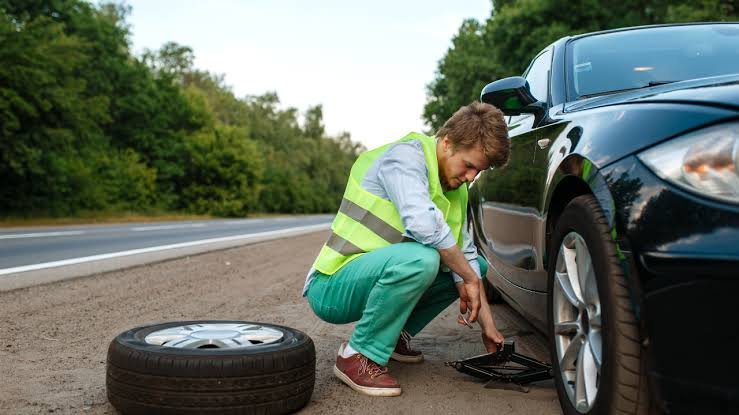
A puncture is by far the most common breakdown scenario on Uganda’s safari circuit, and a tyre change on Uganda’s murram roads is a situation that most self drive visitors will encounter at least once across a multi-park circuit. Every rental vehicle in a properly equipped Uganda self drive fleet carries a full-size spare tyre, a jack, and a wheel brace in the vehicle at the point of collection — verify that all three are present and the spare is properly inflated before departing the hire company premises. The tyre change procedure itself is the same as anywhere, but Uganda’s murram road surfaces require care about jack placement — finding a stable, firm surface for the jack base on a loose or soft shoulder can require moving the vehicle slightly to a firmer section of verge. Once the spare is fitted, the punctured tyre should be taken to the nearest town for repair rather than continuing the circuit with no spare — Uganda’s tyre repair shops in market towns handle puncture repairs quickly and inexpensively, and continuing without a spare on Uganda’s roads means a second puncture leaves the vehicle immobile. Inform the hire company of the puncture even if you have changed the tyre successfully, so the vehicle’s tyre record is updated.
Breakdowns in Remote Locations
The breakdown scenario that requires the most careful planning is a mechanical failure in one of Uganda’s most remote safari locations — the far northeast approach to Kidepo Valley National Park, the Murchison Falls delta tracks on the northern bank, or the Semliki Valley road. In these locations, mobile signal is unreliable or absent on several networks, roadside assistance response times are measured in hours rather than minutes, and the nearest mechanical support is a significant distance away. The practical preparation for remote Uganda driving includes: carrying a fully charged secondary phone with an MTN SIM alongside an Airtel SIM, as the two networks have different coverage patterns and a location with no Airtel signal may have MTN; downloading the hire company’s emergency contact to both devices; knowing the GPS coordinates of your breakdown location so they can be communicated clearly once signal is found; and having sufficient water and food in the vehicle for an extended wait — the recommendation of carrying two to three litres of water per person per day on remote circuits applies to breakdown waits as much as to scheduled driving days. For Kidepo specifically, some experienced Uganda safari operators recommend a satellite communicator device for the northern circuit; our team can advise on this for visitors planning the full northern route.
Mobile Signal in Uganda — What to Expect
Uganda’s mobile network coverage follows population distribution, which means towns, main highway corridors, and the areas around national park gates typically have usable signal on at least one network. The interior game circuits of most parks, remote approach roads, and Uganda’s more isolated rural areas have partial or no signal. MTN Uganda and Airtel Uganda are the two main networks and their coverage differs meaningfully in some areas — carrying SIM cards from both networks on a full Uganda circuit is the most reliable communication approach. Before entering any remote section, attempt to place a check-in call to the hire company while signal is still available, so they know your intended route and expected timing, and can initiate welfare checks if you have not emerged by an expected time. The GPS device included in all our rental vehicles functions without mobile signal — it uses satellite positioning rather than network data — and is unaffected by coverage gaps, making it the navigation tool of choice on remote circuits regardless of phone signal status.
Breakdowns Inside National Parks
A breakdown inside a Uganda national park adds the layer of park regulations to the standard breakdown procedure. Uganda Wildlife Authority rules prohibit walking on foot in the game areas of parks with dangerous wildlife — Queen Elizabeth, Murchison Falls, and Bwindi all have wildlife that makes roadside waiting outside the vehicle genuinely dangerous. The correct procedure for a breakdown inside a Uganda national park is to remain in the vehicle, call the park gate or UWA ranger post using any available signal, and wait for a ranger to reach your position. UWA rangers patrol the main game circuits of Uganda’s major parks and can reach a stationary vehicle within a reasonable time on the primary tracks; their vehicles can also tow or push a stranded vehicle to a safer location while the hire company’s roadside assistance is coordinated. The hire company emergency number and the park’s ranger contact number should both be saved to your phone before entering any park gate.
Reducing Breakdown Risk Before Departure
The most effective breakdown management is prevention, and the pre-departure vehicle check is the most valuable few minutes of any self drive safari. Before leaving the hire company, verify: tyre condition on all four wheels and the spare; engine oil and coolant levels; fuel level and the location of the nearest fuel station en route; that all lights function; that the warning triangle, jack, and wheel brace are in the vehicle; and that the GPS device is charged and loaded with offline Uganda maps. Choosing the right vehicle for your circuit is itself a form of breakdown prevention — a Toyota RAV4 Safari pushed onto approach roads that genuinely require a Toyota Land Cruiser Prado accumulates mechanical stress that a correctly specified vehicle would not, and vehicle under-specification is a contributing factor in Uganda breakdown scenarios that could have been avoided. Browse our Uganda self drive packages and best 4×4 car hire deals to match your vehicle to your circuit before your safari begins.
Related posts

Leave a Comment