
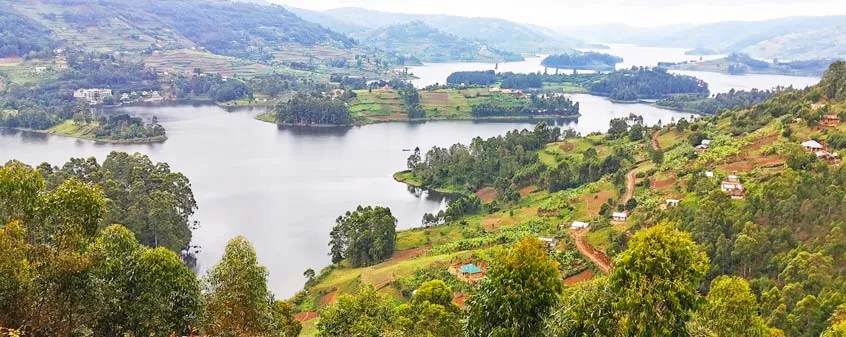
Kigali to Lake Bunyonyi.The drive from Kigali to Lake Bunyonyi is one of the most beautiful cross-border road journeys in East Africa — a route that carries you from Rwanda’s immaculate, hill-terraced capital through the dramatic highlands of the Virunga foothills, across the Uganda border at Katuna, and into the steep Kigezi highlands that frame one of the most visually extraordinary lakes on the African continent. Lake Bunyonyi sits at 1,962 metres above sea level in a flooded valley of the Kigezi highlands of southwestern Uganda, its surface scattered with 29 islands and its shores hemmed in by the steep, green hills that give this part of Uganda its nickname — the Switzerland of Africa. It is one of the few lakes in Africa declared safe for swimming, its waters are bilharzia-free, and the views from the lake’s shoreline lodges and island camps across the mirror-still water to the surrounding hills are among the finest in the region. For self drive visitors travelling from Kigali, Lake Bunyonyi is a natural first overnight stop on the Uganda side of the border — a place to breathe, acclimatise to Uganda, and rest before continuing to Bwindi Impenetrable National Park for gorilla trekking or looping north to Queen Elizabeth National Park for game drives. This complete guide to the Kigali to Lake Bunyonyi self drive covers the route, the border crossing, the lake itself, and how to weave it into a broader Uganda road trip.
Distance and Driving Time from Kigali to Lake Bunyonyi
The distance from Kigali to Lake Bunyonyi via the Katuna–Gatuna border crossing is approximately 220 to 240 kilometres, and the drive takes between three and a half and five hours in normal road conditions including border processing time. This makes it one of the shorter cross-border drives in the region — entirely achievable as a comfortable morning’s journey that leaves the rest of the day for lake activities, a canoe trip to one of the islands, or simply sitting on a verandah watching the highland mist roll across the water. The route runs south from Kigali on the main Kigali–Huye highway through Rwanda’s green southern interior, before turning east and crossing into Uganda at the Katuna–Gatuna border post south of Kabale. From the border at Gatuna, Lake Bunyonyi is just 15 kilometres to the north via Kabale town — a final short drive through the Kigezi highlands that delivers you to the lake viewpoint with a sense of arrival that the journey genuinely deserves. All cross-border vehicles from our Rwanda and Uganda self drive fleet include full documentation for the Katuna–Gatuna crossing and GPS maps loaded for both countries.
The Route — Kigali to Katuna Border via Rwanda’s Southern Highway
From Kigali the road south to the Uganda border runs on excellent, well-maintained tarmac through Rwanda’s most productive agricultural heartland — a landscape of rolling hills terraced with tea, sorghum, banana, and pyrethrum that is quintessentially Rwandan in its meticulous, organised beauty. The first major town on the route is Huye, approximately 130 kilometres south of Kigali and two hours into the drive — a university town with a distinctly academic character and home to the National Museum of Rwanda, one of the finest ethnographic museums in East Africa and a worthwhile two-hour stop for visitors with time to spare. From Huye the road continues south through Butare and Nyanza — passing close to the Nyanza Royal Palace, the beautifully reconstructed residence of Rwanda’s pre-colonial monarchy — before reaching the border town of Katuna on the Rwanda side. The drive from Kigali to Katuna is straightforwardly enjoyable on good tarmac throughout, and the rolling southern Rwanda landscape has a quiet, pastoral beauty that rewards unhurried travel. Rwanda enforces a 60 km/h speed limit on open roads and speed cameras operate on this route, so maintaining legal speeds is both a legal requirement and a safe driving practice.
Crossing the Katuna–Gatuna Border into Uganda
The Katuna–Gatuna crossing is the busiest and most commercially active border between Rwanda and Uganda, and it is well-staffed and efficiently managed for passenger vehicle crossings with correct documentation. Allow between one and two hours for the full crossing process — Rwanda exit procedures, transit across no-man’s-land, Uganda entry stamp, vehicle documentation verification, and Yellow Fever certificate check. Uganda requires a valid Yellow Fever vaccination certificate for all arriving travellers and immigration officers enforce this requirement consistently — ensure your certificate is current, in the original yellow booklet or WHO-approved digital format, and easily accessible alongside your passport. Your rental vehicle must have cross-border authorisation explicitly stated in the rental agreement, and dual-country insurance covering both Rwanda and Uganda must be carried in the vehicle at all times. The most important driving adjustment on the Uganda side of the crossing is the immediate switch to left-hand traffic — Rwanda drives on the right, Uganda drives on the left, and this change applies from the very first metre beyond the Gatuna border post. Take the initial kilometres from the border slowly and deliberately until left-hand driving feels settled. Our airport vehicle handover service and cross-border rental briefings cover all of these border crossing details as standard.
From Kabale to Lake Bunyonyi — The Final Descent to the Lake
From the Gatuna border post the road north to Kabale covers approximately 15 kilometres of gently rising highland road into the centre of Kabale town — one of Uganda’s most attractive provincial towns, perched on its own hilltops at over 1,800 metres and surrounded by the steep, terraced farmland of the Kigezi highlands. Kabale is an important fuel stop and the best place to stock up on food, water, and supplies before settling in at the lake — fill up here as fuel stations near Lake Bunyonyi are limited. From Kabale, Lake Bunyonyi is just 6 kilometres to the northwest on a road that descends steeply through the highland communities before the lake suddenly reveals itself below in a panoramic sweep of island-dotted water that genuinely stops you in your tracks the first time you see it. The lake viewpoint above the main shoreline is one of Uganda’s finest scenic moments — take it slowly on the descent and find a spot to stop and absorb the view before continuing to your accommodation. Most lodges and campsites on Lake Bunyonyi are accessible directly by vehicle, though some island accommodation requires a short canoe or motorboat transfer arranged by the property.
What to Do at Lake Bunyonyi
Lake Bunyonyi is not primarily a wildlife destination in the traditional Uganda safari sense, and that is exactly why it works so well as a rest and recovery stop between the intensity of a Rwanda highlight and the physical demands of gorilla trekking at Bwindi Impenetrable National Park. The lake’s principal pleasures are its extraordinary visual beauty, its remarkable tranquility, and the range of gentle activities it offers to visitors who have been driving hard. Swimming in the bilharzia-free waters is the most immediately appealing activity — a genuine luxury on a Uganda road trip where most lakes and rivers are not safe for swimming. Dugout canoe hire from most shoreline lodges allows you to paddle between the lake’s 29 islands at your own pace — Bushara Island, accessible by canoe in about 20 minutes, is the most visited and has a popular community campsite and trail system. Birding around the lake margins and in the shoreline swamp vegetation is outstanding, with African green broadbill, papyrus gonolek, and white-winged warbler among the regional specials accessible on a morning walk. The lake’s highland sunsets, viewed from a shoreline lodge verandah with a cold Nile Special beer, are some of the finest in Uganda.
Lake Bunyonyi as a Base for Bwindi and Beyond
The most compelling reason to include Lake Bunyonyi on a Kigali-origin Uganda self drive is its perfect position as a staging post between the Rwanda border crossing and Bwindi’s gorilla trekking sectors. From Lake Bunyonyi, Bwindi’s Buhoma sector is approximately 80 kilometres and two to three hours via Kabale and the Kabale–Buhoma gravel road. The Rushaga sector is slightly closer via a different southern approach through Kanungu. Spending one or two nights at Lake Bunyonyi before trekking gorillas at Bwindi is the ideal preparation — well-rested, acclimatised to the altitude of Uganda’s southwest, and mentally refreshed for what is one of the most physically and emotionally demanding wildlife experiences available anywhere on earth. After Bwindi, self drive visitors continuing north to Queen Elizabeth National Park can return via Lake Bunyonyi and Kabale before heading north through Mbarara to the park — a routing that our 7-day best of Uganda tour follows as part of a complete western Uganda circuit. For the full dual-country experience, our 10-day Rwanda Uganda safari weaves Lake Bunyonyi into a seamless circuit covering Rwanda’s gorillas, Uganda’s gorillas, Queen Elizabeth, and Kibale Forest. Browse our Uganda safari packages and cross-border car hire options, or contact our team today to plan your Kigali to Lake Bunyonyi self drive and everything that waits beyond it.
Related posts

Leave a Comment