
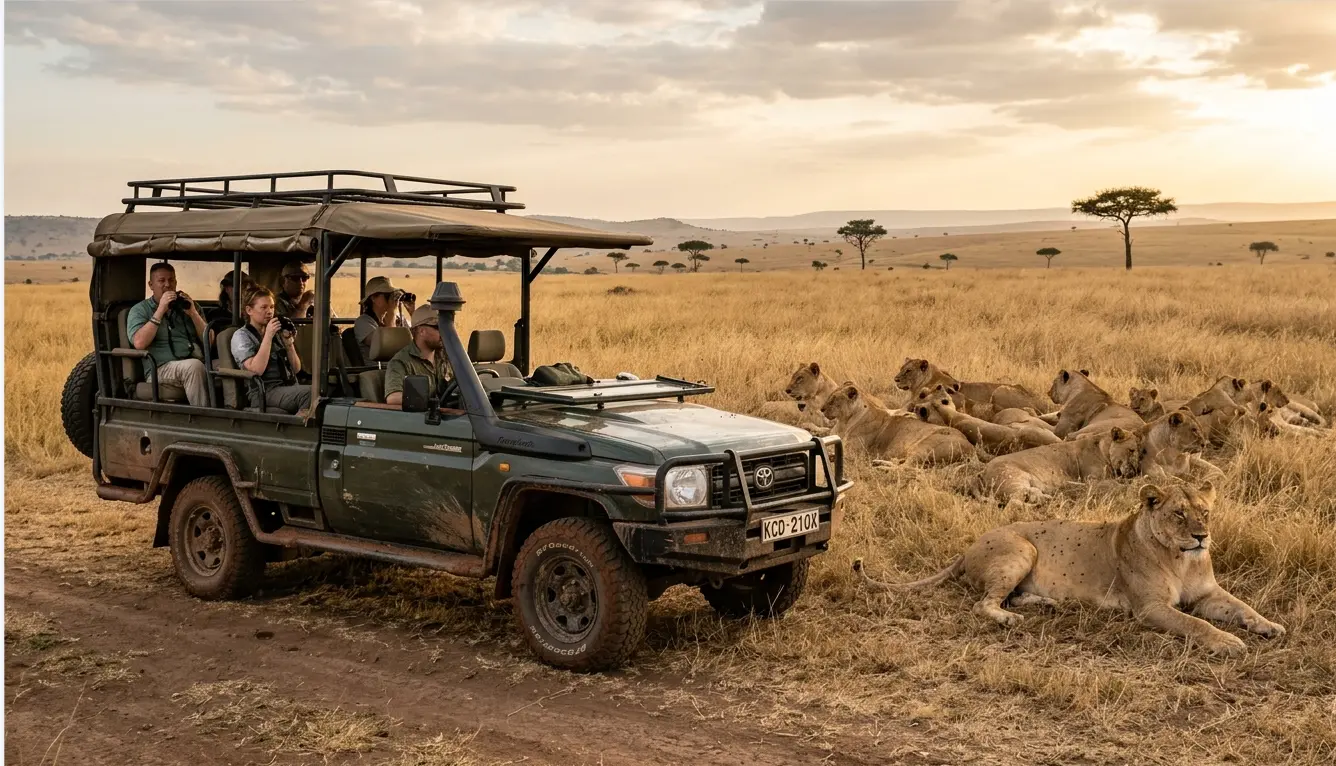
Self-Drive vs Driver-Guided Safaris in Uganda. It is one of the first and most important decisions every Uganda-bound traveller faces — and it is one that shapes the entire character of your safari. Do you take the wheel yourself, navigating Uganda’s red-dust roads and national park tracks at your own pace and on your own terms? Or do you hand the driving to an experienced local guide who knows every waterhole, every shortcut, and every trick for finding a pride of lions on a quiet Tuesday morning in Murchison Falls?
Both approaches offer a genuinely exceptional way to experience the Pearl of Africa. Both have real advantages and real trade-offs. And the right answer depends not on which option is objectively better — because neither is — but on who you are as a traveller, what you value most in a safari, and how you want to spend your days in one of the world’s most remarkable wildlife destinations. At Self Drive Safaris Uganda, we offer both options, and our honest advice is always the same: understand what each delivers, then choose the one that fits your travel personality.
This guide lays out the comparison clearly, fairly, and in full — so you can make the decision with confidence.
What Is a Self-Drive Safari in Uganda?
A self-drive safari means renting a 4×4 vehicle and taking full control of your own itinerary — planning your own routes, setting your own wake-up times, choosing where to stop and for how long, and navigating Uganda’s national parks and highways independently. You are the driver, the navigator, and the decision-maker for every hour of the journey.
Self-drive safaris in Uganda are conducted in well-maintained 4×4 vehicles — most commonly the Toyota RAV4, Toyota Land Cruiser Prado TX, or Land Cruiser V8 — rented from a reputable car hire operator. Park entry fees, gorilla or chimpanzee trekking permits, and accommodation are arranged separately, and within each national park, Uganda Wildlife Authority rangers are available to accompany you on specific activities such as walking safaris and night drives. For game drives through the park on the main circuit roads, you navigate independently at your own pace.
Self-drive safaris in Uganda are a growing and well-established option. Uganda’s main highways are in excellent condition, national park maps and GPS apps are widely available, and the park circuit roads — while unpaved — are navigable in a capable 4×4 for any driver with reasonable off-road confidence. The experience attracts independent travellers, photography enthusiasts, couples, families, and adventure travellers who regard the journey itself as part of the experience rather than simply a means of getting between sightings.
What Is a Driver-Guided Safari in Uganda?
A driver-guided safari means hiring a vehicle that comes with a professional driver guide — a locally trained, licensed, and experienced individual who drives you throughout your safari, handles all navigation and logistics, and shares their knowledge of Uganda’s wildlife, culture, parks, and routes throughout the journey. In Uganda, the best driver guides hold Uganda Wildlife Authority guide certifications and have years of experience across multiple national parks.
The driver guide is simultaneously your chauffeur, your wildlife interpreter, your logistics coordinator, and your local connection to the places you are visiting. A good driver guide knows which waterholes the elephants are using this week, which road through Queen Elizabeth currently gives the best chance of finding lions, and how to time your arrival at the Murchison Falls boat jetty to avoid the queue. They handle the park gate procedures, the game drive route planning, and the communication with other drivers on the ground — including the informal radio network through which guides share real-time wildlife sightings across a park.
Driver-guided safaris in Uganda are the more traditional format and remain the most popular choice among first-time Uganda visitors, travellers who are not confident driving on unfamiliar roads, solo travellers, and those who want to maximise their wildlife sighting success without the cognitive load of self-navigation.
Cost Comparison: Self-Drive vs Driver-Guided
Cost is often the first point of comparison, and the picture is more nuanced than it might initially appear. Self-drive is widely marketed as the budget option, and for solo travellers or couples, the savings on daily driver guide fees — typically USD 25 to USD 50 per day above the vehicle rate — can be meaningful over a ten-day safari. However, for groups of four or more splitting a single vehicle, the per-person cost of a driver guide drops significantly and begins to look like very good value for the service received.
For a couple travelling independently on a self-drive safari, the daily vehicle cost might be USD 70 to USD 100 for a Land Cruiser Prado. Adding a driver guide brings this to USD 95 to USD 150 — a difference of roughly USD 25 to USD 50 per day, or USD 12 to USD 25 per person per day. Against the backdrop of gorilla permits at USD 800 per person, nightly lodge fees, and park entry, this is a relatively modest increment for what a skilled driver guide delivers.
It is also worth noting that driver guides typically require their accommodation and meals to be covered — usually an additional USD 25 to USD 35 per day — and that some lodges offer discounted rates to guests arriving with established local operators, which can partially offset the additional guide cost. The honest calculation is that self-drive is cheaper for independent travellers with strong driving confidence, but the cost advantage narrows considerably for larger groups and longer trips.
Freedom and Flexibility: Where Self-Drive Wins
On the question of freedom and flexibility, self-drive safaris hold a clear and genuine advantage that no guided format can fully replicate. When you are behind the wheel of your own vehicle, every decision belongs to you — and that quality of ownership over your own experience is something that many travellers value enormously.
On a self-drive safari in Uganda’s national parks, you can linger at a cheetah sighting for as long as the animal remains visible, without any pressure from a driver watching the clock. You can take a different circuit road because you noticed something in the bush that caught your eye. You can leave for your morning game drive at 5:30 am rather than 6:30, because the light at first dawn is the light you came for and no schedule should compromise it. You can pull over by a lake and eat your packed lunch in total silence while a fish eagle calls overhead — and nobody is waiting for you.
For photographers especially, self-drive offers a particular kind of creative control. You position the vehicle for the angle you want, you wait for the moment you are envisioning, and you decide when the shot is done. This level of creative autonomy is genuinely difficult to replicate in a guided vehicle where the driver’s timing and positioning — however skilled — is ultimately not yours.
For travellers who experience a guided tour as a constraint rather than a support — who find that following someone else’s rhythm diminishes rather than enhances their enjoyment — self-drive is not merely a cheaper option. It is a fundamentally better fit for the kind of traveller they are.
Wildlife Sighting Success: Where Guided Has the Edge
On the question of wildlife sighting success — finding animals efficiently, identifying species accurately, and understanding what you are watching when you find them — the driver-guided safari holds a significant and honest advantage that self-drive travellers should acknowledge before they choose.
An experienced Uganda driver guide has spent years learning the behaviour patterns of the wildlife in each park they work in. They know that lions in Murchison Falls tend to rest in the shade near the Warwick Track between 10 am and 3 pm during the dry season, and that the best time to find elephants near the Albert Nile is at first light. They know which tree in which valley the leopard has been using as a daytime rest site this month, because they spoke to three other guides yesterday who saw it there.
This accumulated, real-time, locally specific knowledge is impossible to replicate from a guidebook, a GPS app, or a wildlife documentary. And it is shared through the informal radio network that connects driver guides across every major Uganda national park — a continuous, live conversation about what has been seen, where, and when. A self-drive visitor driving the same circuit roads at the same time as a guided vehicle may have an excellent experience, but they will not have access to this network, and they will miss some sightings that the guided visitor does not.
Beyond finding animals, a driver guide gives you the full context of what you are observing. Understanding that the male lion moving stiffly toward the shade is the pride dominant whose territory was recently challenged, or that the elephant herd clustering close together is responding to a distant threat — this is the interpretive layer that turns wildlife observation into genuine wildlife understanding, and it is something a skilled guide delivers naturally throughout the day.
Navigation and Logistics: The Practical Case for Guided
Uganda’s national park roads are manageable in a 4×4 for a confident driver, but navigating them for the first time without local knowledge does involve a meaningful learning curve. Park circuit roads are not always clearly marked, distances between landmarks can be deceptive, and the consequences of taking a wrong turn in a remote section of Kidepo Valley National Park or the northern reaches of Murchison Falls are more significant than missing an exit on a motorway.
A driver guide removes all of this cognitive burden entirely. They know every junction, every shortcut, every section of road that becomes impassable after rain, and every park gate procedure. They handle the paperwork at each checkpoint, communicate with park rangers in the local language, and manage the timing of activities — boat cruise departures, chimp briefings, gorilla trekking assembly points — with a practiced efficiency that takes first-time visitors much longer to coordinate independently.
For travellers visiting multiple parks across a ten to fourteen day Uganda circuit — combining Murchison Falls, Kibale Forest, Queen Elizabeth, and Bwindi — the logistical complexity of coordinating routes, timing, permits, and accommodation transitions is substantial. A driver guide absorbs this complexity entirely, leaving you free to be fully present in every experience rather than mentally managing the next stage of the journey.
Safety and Confidence on Uganda’s Roads
Road safety is a consideration that honest Uganda safari operators discuss openly. Uganda drives on the left, and the combination of unfamiliar road rules, fast-moving traffic on the main highways, large potholes on secondary roads, and the occasional livestock crossing demands a level of attentiveness that can be fatiguing over long distances. Night driving in Uganda is strongly discouraged for all visitors — guided or self-drive — due to reduced visibility, unmarked hazards, and the increased risk of wildlife on the road after dark.
For first-time visitors to East Africa, or for travellers who have not driven in an African country before, the early days of a self-drive safari in Uganda can carry a tension that diminishes the enjoyment of the journey. A driver guide removes this entirely — you are a passenger, free to watch the landscape, observe the roadside wildlife, and rest between parks rather than concentrating on the road ahead.
In the event of a vehicle breakdown — which is rare with a well-maintained rental fleet but does occasionally occur — a driver guide handles everything: the roadside assessment, the call to the rental company, the coordination of a replacement vehicle or roadside assistance. For a self-drive visitor in a remote area with limited phone signal, the same situation requires considerably more self-reliance and composure.
Who Should Choose Self-Drive?
A self-drive safari in Uganda is the right choice for travellers who are confident and experienced drivers on unpaved roads, who have visited African national parks before or are comfortable navigating unfamiliar environments independently, who value creative control and spontaneity over efficiency and guided interpretation, who are travelling as a couple or small group and want total privacy and flexibility throughout the safari, and who regard the independence of the open road as an intrinsic part of the travel experience rather than a logistical necessity.
It is also an excellent choice for travellers who are visiting Uganda’s more accessible parks — Lake Mburo, Queen Elizabeth via the main circuit, Kibale Forest — where the roads are well-maintained, the park layouts are straightforward, and the wildlife is abundant enough that an experienced driver guide’s real-time knowledge advantage is less decisive than it might be in a vast and remote park like Kidepo.
Who Should Choose a Driver-Guided Safari?
A driver-guided safari in Uganda is the right choice for first-time visitors to Uganda or East Africa who want the reassurance of local expertise from day one, for travellers whose primary goal is maximum wildlife sightings and who want the benefit of the guide network and real-time knowledge, for solo travellers who appreciate the company and security of an experienced local companion, for families with children who want logistics handled professionally so that every experience is relaxed and well-managed, and for travellers visiting remote or technically demanding destinations such as Kidepo Valley National Park or the upper approaches to the Rwenzori Mountains.
A driver-guided safari is also the right choice for any traveller who has ever felt that the logistics of self-organising a complex itinerary competed with their enjoyment of the destination itself. The best safaris are the ones where you are fully present — and if a driver guide is what makes that possible, then a driver guide is an investment, not an expense.
The Best of Both: A Hybrid Approach
Many experienced Uganda travellers recommend a middle path that combines the freedom of self-drive with the support of local expertise — renting a self-drive vehicle for the main highway sections and more accessible parks, while hiring a driver guide specifically for the most demanding or remote legs of the journey, such as the approach to Bwindi or the Kidepo circuit. This hybrid approach gives you the independence you value where the roads are straightforward, and the support you need where the roads — and the wildlife — are most challenging.
At Self Drive Safaris Uganda, we offer flexible arrangements for exactly this kind of mixed itinerary. Whether you want a fully self-drive fleet, a driver-guided vehicle, or a combination of both across different sections of your Uganda safari, we can build the arrangement that fits your travel style, your budget, and your destinations. Browse our Uganda self-drive safari options and driver-guided vehicle fleet and get in touch with our team today — we will help you make the choice that turns your Uganda safari into the journey you have always imagined.
Related posts

Leave a Comment